OUT OF AFRICA
COINS & CURRENCY OF AFRICA
 THE
COIN WITH A SOUL!
THE
COIN WITH A SOUL!

The "Kissie Penny" or "Gizzie Iron" are twisted iron rods, about 10
inches (18 to 24cm) long, that were used for money in Liberia
and Sierra Leone from the 19
th to the mid 20
th
century. They were said to contain a soul. If the Kissie were broken,
the soul would escape and it would be valueless. Of course, the local
"witch doctor" could restore the soul, for a small fee. A
bunch of bananas might cost 2 Kissies, a cow 2000 Kissies, or a bride
4000 Kissies.
Item
KISSIE WEST AFRICAN KISSIE PENNY $7.00
Item
KISSIEx5 5 PIECES OF WEST AFRICAN KISSIE
PENNY $20.00
AFRICAN
SLAVE
BRACELET MONEY

Reduced size image
The Manilla, also called "slave bracelet money" was used extensively on
the "slave coast" of west Africa. The Manilla comes in various sizes
and forms,
though it was usually made from a copper and lead alloy. The value
fluctuated from time to time and place to place. Manillas were often
manufactured in Europe for use in the African slave trade. In the 15
th
and 16
th century male slaves went for 2 to 10
Manillas each. By the time the Manilla was demonitized in Nigeria in
1947 it was worth only 3 pence. This Manilla is
about 2.25 to 2.5 inches (6 cm.) across and was used from the
18
th
to the mid 20
th Centuries.
Item
MANILLA WEST AFRICAN MANILLA
$15.00
Item
MANILLAx5 5 of the above WEST AFRICAN
MANILLAS
$49.50
AFRICAN UNION 2026 10 AFRO
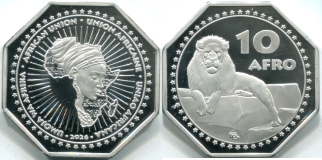
This
unofficial 2026 10 Afro coin of the African Union features a lion on
the reverse and a women's face superimposed on a map of
Africa on the
obverse. It has legends in Swahili, English, French and
Portuguese.
The long term goals of the African Union include promoting sustainable
economic and social development, closer integration of the African
economies, visa free travel throughout the continent and a single
currency throughout Africa. The 40mm, eight-sided, silver
plated Proof
coin has a mintage of just 110 pieces.
Item
AFR.UNION AFRICAN UNION 10 AFRO 2026 PROOF $25.00
AFRICAN
COINS
FEATURE TRADITIONAL AFRICAN MONEY 
Six member nations of the African Development Bank issued a
series of coins, each of which features a form of traditional money
used
in the member nation. Each coin bears the denomination of
1500
CFA Francs. The coins are 27mm nickel-plated steel and are dated
2005. One side features an
Elephant’s head and a map of Africa while the other features a form of
traditional
money. The Cameroon issue features a Mambila. Three pieces of
Spear
Money is shown on the coin of the Central African Republic. A
Manilla
is shown on the Chad issue. A 333 Cross is on the coin
from
the
Congo Republic. A pair of Cowrie shells is on the Equatorial
Guinea
coin. The Gabon coin shows a piece of Throwing Knife
Money. Each coin has a mintage of only 2005 pieces!
Individually
they are interesting coins. As a
set they display the
wide range of items used for money in Africa prior to the introduction
of
coins and currency.
Item
CM-PRIM CAMEROON 1500 FRANCS 2005 Mambila
Br.X26 Unc. $9.50
Item
CF-PRIM CENTRAL AFRICAN REPUBLIC 1500 Francs
2005 Spear Money Br.X12
Unc. $9.50
Item
TD-PRIM CHAD 1500 Francs 2005
Manilla Br.X19
Unc.$17.50
Item
CG-PRIM CONGO REPUBLIC 1500 Francs 2005
Katanga Cross Br.X46 Unc.
$9.50
Item
GQ-PRIM EQUATORIAL GUINEA 1500 Francs 2005
Cowries Br.X124 Unc.
$9.50
Item
GA-PRIM GABON 1500 Francs 2005 Throwing knife
Money Br.X16
Unc. $9.50
Item
AFRICA-PRIM6 SET OF ABOVE 6 AFRICAN COINS
PICTURING PRIMITIVE MONEY Unc.
$59.00
AFRICAN BI-METALLICS
CELEBRATE VISITS
BY POPE JOHN PAUL II
In 2007 five African nations: Cameroons, Central African
Republic, Chad, Congo Republic and Gabon, each issued a bi-metallic
4500 Franc coins to commemorate a visit that Pope John Paul II made to
their country. The coins were made by the Africa Mint, which
had
questionable authority to issue the coins. The coins have a
mintage of
only 2007 pieces of each coin. Due to a fortunate purchase we
are able
to offer these scarce coins far below their original issue price of 50
Euros ($60) each. Each coin pictures the Pope and lists the
date of
his visit The Central African Republic and Congo
issues also show an
airplane, while the Chad issue also shows the Popemobile. The
reverse
of the coins all show a map of Africa and an elephant head. Because
these nations use the common currency of the Central African Monetary
Union they issue few coins of their own.
Item
CM-POPE07
CAMEROON 4500 FRANCS 2007 PAPAL VISIT Br.X32
UNC.
$15.00
Item CF-POPE07
CENTRAL AFRICAN REPUBLIC 4500 FRANCS
2007 PAPAL VISIT Br.X13 UNC.
$15.00
Item TD-POPE07
CHAD 4500 FRANCS 2007 PAPAL VISIT Br.X28
UNC. $15.00
Item CG-POPE07
CONGO REP. 4500 FRANCS 2007 PAPAL VISIT Br.X49
UNC
$15.00
Item GA-POPE07
GABON 4500 FRANCS 2007 PAPAL VISIT Br.X17 UNC
$15.00
Item ALL-POPE07
ALL 5 OF THE ABOVE 4500 FRANCS 2007 PAPAL
VISIT COINS UNC
$65.00
SCARCE
BI-METALLIC
AFRICAN PRESIDENTS COINS
In an effort to improve relations with top African leaders, (and
perhaps secure contracts to issue more coins), the Africa Mint issued a
series of coins in 2003 honoring the Presidents of various African
nations. Each of the four bi-metallic coins are 28mm in diameter and
bear the denomination of 6000 Francs. Included are Mathieu
Kerekou of Benin, Paul Biya of Cameroon, Mamadou Tandja of
Niger and Gnassingbe Eyadema of Togo. Each coin pictures the
respective president, the national flag superimposed upon a map of the
nation, along with the dates President’s term in office. Only
one President (Kerekou of Benin) actually retired when his term was
up. The reverse of the coins picture an elephants head on a
map of Africa, along with an inscription honoring the
President. Only 500 of each coin was issued.
Item BJ-PRES
BENIN 6000 FRANCS 2003 Br.X41 PRES. KEREKOU
UNC.
$29.50
Item CM-PRES
CAMEROON 6000 FRANCS 2003 Br.X27 PRES. BIYA
UNC. $29.50
Item NE-PRES
NIGER 6000 FRANCS 2003 Br.X14 PRES. TANDJA
UNC. $59.95
Item TG-PRES
TOGO 6000 FRANCS 2003 Br.X22 PRES. EYADEMA
UNC. out
Item
CI-PRES
IVORY COAST 6000 FRANCS 2003
Br.X7 PRES.
GBAGBO UNC. $39.50
ANIMALS FROM
ALGERIA

This 10-coin set from Algeria features animal and bi-metallic
coins. The 1/4 Dinar shows a desert fox, the 1/2 Dinar
features a Barbary Horse. A prehistoric sheep is on the 1 Dinar, a
Camel is on the 2 Dinar, an Elephant is on the 5 Dinar. The 10 Dinar is
made from an unusual bi-imetallic combination with an aluminum center
surrounded by a steel ring. The coin features a falcon. The 20 Dinars
has a lion's head. The 50 Dinars shows a Gazelle, The 100
Dinars depicts a horse's head. The 2012 dated 200 Dinars
commemorates the 50th anniversary of Algeria's independence from
France. The 1/4 Dinar is aluminum, 1/2, 1, 2 and 5 Dinars are stainless
steel and the 10, 50, 100 and 200 Dinars are bi-metallic. The coins
date from 1992 to 2018 and are Uncirculated. It is a scarce
and rarely seen set.
Item
ALG-SET10 ALGERIA 10 COIN SET, 1/4 TO 200
DINARS
1992-2018, UNC. $25.00
SCARCE
PORTUGUESE ANGOLA COIN

Portuguese
explorers reached Angola in 1484. Portugal established settlements and
trading posts along the coast in the 16th century. Much of
the trade consisted of exchanging manufactured European goods for
slaves from local slave traders then exporting the slaves to
Brazil. Though the slave trade was formally abolished in
Angola in 1836, it continued illegally for some years.
Portuguese control of Angola slowly extended inland in the 19th
century, though the boundaries were not finally delineated until the
1920's. A war for independence broke out in 1961 that
continued until independence was finally granted in
1975. Upon gaining independence a civil war erupted
in Angola between various pro-independence factions, which continued
for another 27 years. This 1967 Portuguese Angola 2
1/2 Escudos was struck in Lisbon during Angola's war for Independence.
The 20mm copper-nickel coin features the coat of arms of Portuguese
Angola on one side and the and Portugal's national emblem on the
other.
Item
AO-2.5E PORTUGUESE ANGOLA 2 1/2 ESCUDOS 1967
KM77 BU $6.00
ANGOLA
CELEBRATES PEACE
& RECONCILLIATION

The
Angolan civil war broke out immediately after the country was
granted independence from Portugal. Three factions that had
been
fighting for independence started fighting each other for control of
the nation. Fighting continued sporadically for 27 years
until a
lasting peace agreement was finally achieved in 2002. Angola
issued this commemorative 200 Kwanza coin in 2022 to celebrating 20
years of Peace and Reconciliation following the end of the civil wars
in 2002. The obverse depicts two people embracing each
other. The reverse features the denomination and a native
pattern. Within the last zero of the denomination is a latent
image that changes from "200" to "BNA" (National Bank of Angola) as the
coin is tilted. The 28.5mm nickel clad steel coin was struck
at the Moscow mint.
Item
AO-200K ANGOLA 200 KWANZAS 2022 PEACE
&
RECONCILLIATION KM114 UNC.
$6.00
MULTI-CURRENCY
COIN FROM BENIN

This
unusual coin of Benin is denominated in
three different currencies! The coin is denominated in the
local currency: 1500 CFA Francs, a common currency used by a number of
African nations that were once French colonies. More unusual
is that the coin is also denominated as 2.30 Euros and 3.45 Swiss
Francs. The 2005 coin was issued to honor (and sell at) the
2005 coin fairs in Basel, Switzerland and Piacenza, Italy. The coin
features a map of Europe highlighting the 25 members of the European
Union plus Switzerland one one side, and a map of Africa on the
other. The coin has a mintage of only 2005 pieces.
Item
BJ-EU BENIN 1500 FRANCS, 2.30 EUROS, 3.45
SWISS FRANCS, 2005 KM44, Br.X44 UNC. $8.50
SCARCE
BANKNOTE FROM SHORT-LIVED
BIAFRA
After years of persecution by the Muslim majority who controlled
Nigeria, the oil-rich and heavily Christian south-eastern portion of
the country declared itself the independent Republic of Biafra in May,
1967. The independence was to be short-lived however. After over two
years of bloody civil war, in which as many as two million people died,
Biafra was forced to surrender to Nigeria in January of 1970.
In 1968 Biafra contracted to have banknotes
printed by Casa de Moeda in Portugal. The undated 1 Pound
note is
green and features a small palm tree on the front and the Biafran arms
on the back.
Item
PM-BIA-1P BIAFRA 1 POUND NOTE
(1968-69) P5a UNC.
$4.00
BURUNDI
COIN SET

Burundi
is a small, landlocked nation in central Africa. Because it
does
not have a mint of its own, it rarely issues coins. The four
coin
set includes the most recent coins of Burundi, though some are decades
old. Included is the 2011 nickel-plated steel 50
Francs
depicting a drummer holding a
drum on his head. Drumming is an important part of Burundi’s
culture and their drummers have achieved worldwide fame. The
2011
nickel-plated steel 10 Francs depicts bunches of bananas.
Both coins have the name of the country and legends in three
languages on the obverse. The 1980 5 Francs and the 2003 1
Franc
both feature the national arms and are struck in aluminum.
Item S-BI-SET4
BURUNDI 4 COIN SET, 1 - 50 FRANCS 1980-2011
KM19-22 UNC. $8.00
SCARCE
SOCCER COINS FROM CAMEROON
To commemorate the 2006 World Cup Soccer Games in Germany, two versions
of the 2006 nickel-plated iron 1500 Francs coins were issued by
Cameroon. The coins are quite similar. They both
depict a player kicking a ball into the Brandenburg Gate and a map of
Africa on the obverse, and an elephant head and a map of Africa of the
reverse. The only difference between the two is that one
version has a small Brandenburg Gate “privy mark” behind the player and
the other does not. The coins have a mintage of only 5000
pieces each.
Item CM29-NP
CAMEROON 1500 FRANCS SOCCER KM29 WITHOUT
“privy
mark” UNC.
$19.95
Item CM30-PRIV
CAMEROON 1500 FRANCS SOCCER KM30 WITH “privy
mark” UNC.
$19.95
Item CM-BTH
BOTH OF THE ABOVE BRANDENBURG SOCCER COINS,
UNC.
$35.00
STRANGE
PYGMY COINS
FROM
CAMEROONS


These
two
2004 dated 750 Franc coins from the Cameroons are a bit unusual. Both
coins have the same design; however one is bi-metallic while the other
struck in blue cobalt plated iron., giving it a slight blueish
tinge. They honor the Pygmies and feature a small
standing
pygmy on one side. The other side features an elephant’s head
on
a map of Africa. The coins are 20mm in diameter.
Only 2500
of the blue cobalt plated iron coins were struck and 2005 of the
bimetallic coins were struck, making them rather scarce.
Item
CM-25 CAMEROONS 750 FR. BLUE COBALT PLATED
IRON Br,X25 UNC. $19.95
Item
CM-25A CAMEROONS 750FR. BI-METALLIC PYGMY
COIN, Br,X25a UNC. $19.95
CAMEROON
COIN CAN
HONOR YOUR WEDDING OR ANNIVERSARY

A pair of wedding rings and
Champaign glasses are featured on these Cameroon 7500 Franc coins dated
2006. Below the rings is a blank area where you can
engrave names, initials or dates to honor your engagement, wedding or
anniversary. The reverse features an elephant head and a map
of Africa. The 30mm coin is available both in silver-plated
or gold-plated brass. It is an interesting
“customizable” coin.
Item CM-WEDGOLD
CAMEROON 7500 FRANCS WEDDING GOLD-PLATED
Br.X31
UNC.
$15.00
Item CM-WEDSILVER
CAMEROON 7500 FRANCS WEDDING SILVER-PLATED
Br.X31a UNC.
$15.00
POPE
BENEDICT HONORED ON BI-METALLIC CAMEROON COIN

This
unofficial bi-metallic 4500 Franc coin was issued for
Cameroons shortly after the ascension of
Pope Benedict XVI in 2005. The coin features a terrible,
toothy
portrait of Pope Benedict XVI. It makes the Pope
look like
a vampire. A map of Africa and an elephant's head
is on the
reverse.
Item
CM-POPE05
CAMEROON 4500 FRANCS 2005 BENEDICT
XVI Br.X24
UNC-minor spots. $9.50
CAPE
VERDE COIN SET

Cape
Verde is a group of 10 volcanic islands off the coast of
Africa. They were uninhabited until settled by the Portuguese
in 1462. They remained a Portuguese colony until independence in 1975.
The 1982 10 and 20 Escudos feature the busts of two "heroes of
independence" who had little direct involvement with Cape Verde gaining
independence. The 10 Escudos depicts Eduardo
Mondlane. He was a profession of anthropology and history at
Syracuse University prior to returning to Mozambique to lead the
Mozambique Liberation Front (FRELIMO). He was assassinated in
1969. Domingos Ramos, who appears on the 20 Escudos, fought
against the Portuguese in Portuguese Guinea. The denomination
and national emblem is on the reverse of both copper-nickel coins.
Item
CV-SET2
CAPE VERDE 10 & 20 ESCUDOS 1982 KM19 & 20
BU $9.00
CAPE
VERDE CELEBRATES 40th ANNIVERSARY WITH BI-METALLIC

Cape
Verde is a group of ten islands located 350 miles (570 km.) off the
coast of Western Africa. It gained independence from Portugal
in 1975. To celebrate the 40th anniversary of independence,
and the 40th anniversary of its central bank it issued this circulating
28.5mm bi-metallic 250 Escudos dated 2015. One side,
commemorating 40 years of development and features a school teacher,
windmills, a family and other images. The other side
commemorates the 40th anniversary of Banco de Cabo Verde. It
includes the national arms and various monetary and financial symbols
(looks like the designer had fun with the wingdings fonts).
Item
CV-250E
CAPE VERDE 250 ESCUDOS 2015 40th ANNIVERSARY, KM55 UNC. $12.00
WORLD'S
THINNEST, BIGGEST, OPTICAL ILLUSION COINS FROM CHAD
The world's thinnest, biggest optical illusion coins were recently
produced for the African nation of Chad. The 2023 dated 200
Franc coins are only 0.15 mm (0.006 inch) thick yet are 30mm in
diameter. The coins weigh just 1 gram and are made from .999
silver. They come in a protective display case with
Certificate of Authenticity. They are made with high quality,
non-digital printing. One design features "The Black Hole",
the other. "The Illusion Room". Maximum
mintage of each is only 999 pieces. The coins all have a
common obverse that includes the Chad coat of arms, denomination and
date.
Item
TD-HOLE-PF CHAD 200 FRANCS 2023 BLACK HOLE,
SILVER PROOF
$39.75
Item
TD-ROOM-PF CHAD 200 FRANCS 2023 ILLUSION ROOM,
SILVER PROOF OUT
 Click Here for
YouTube video produced by the mint depicting the Illusion Room coins
Click Here for
YouTube video produced by the mint depicting the Illusion Room coins
Click Here for
YouTube video produced by the mint depicting the Black Hole coins
LEOPARD ON
CONGO DEMOCRATIC
REPUBLIC COIN

A
fierce
leopard, crouching on a tree limb and about to pounce, is featured on
this 1967 10 Sengi coin from the Democratic Republic of the
Congo. The 17mm aluminum coin has the date and denomination
on the obverse.
Item
CD-10S CONGO DEMOCRATIC REPUBLIC 10 SENGI
1967 KM7
UNC. $3.00
GREAT
SPHINX ON 1954 EGYPTIAN 1 MILLIEME 

The
Great Sphinx at Giza is featured on the front of this Egyptian 1
Millieme. The back includes the denomination and date in
Arabic. The coin is double dated with both the AH date of
1354 and the AD date of 1954. It was one of the
first coins struck by the Republic of Egypt after the overthrow of King
Farouk in 1952. The aluminum-bronze coin is 16mm.
Item
EG-1M54 EGYPT 1 MILLIEME 1954AD - AH1354
KM375 UNC.
$5.00
Item
EG-1M54x5 5 of the above EGYPT 1 MILLIEME
1954AD - AH1354 KM375 UNC.
$15.00
2021 EGYPTIAN
CIRCULATING COMMEMORATIVE COINS

Egypt
recently released a number of circulating commemorative coins in an
effort to bolster support of the government. The coins have a
common obverse which includes the name of the country in Arabic, the
denomination in Arabic and English and both the AD and AH
dates. The 1 Pound coins are 25mm bi-metallic with a
brass-plated steel center in a nickel-plated steel ring. The
50 Piastres are 23mm brass-plated steel coins.

The 69th anniversary of
National Police Day
is commemorated on a 2021 1 Pound coin. Police Day is in
remembrance of the 50 police officers of the Ismaila Police Station
that were killed or wounded when the British attacked the police
station with tanks on January 25, 1952 after the police refused abandon
the station and hand over their weapons. January 25 was
declared a national holiday in 2009 by Egyptian President Hosni Mubarak
to recognize the efforts of Egyptian police to maintain security and
stability. On Police Day in 2011 widespread protests against police
brutality and corruption led to a revolution which overthrew President
Mubarak. The bi-metallic coin features a winged eagle emblem and the
Arabic numbers 69.
Item
EG-POLICE EGYPT 1 POUND 2021 POLICE DAY UNC.
$4.00
 Egyptian
Medical Teams
Egyptian
Medical Teams are honored on 50 Piastre and 1 Pound
coins. The coins feature four doctors. In order to
avoid offending conservative Muslims, the doctors have no facial
features. The coin is triple dated, bearing the date 2020
beneath the doctors, and AD 2021 and AH 1442 on the obverse.
Item
EG-MED EGYPT 50 PIASTRE & 1 POUND
2020/2021 MEDICAL TEAMS UNC. $5.00

"
Decent
Life" is an initiative of
Egyptian President Abdel Fattah El-Sisi's improve rural areas of
Egypt. The multi-year project, started in 2019, aims to
improve sewer, water, electricity, natural gas and internet access in
villages, improve housing, as well as health and education
projects. The Decent Life 50 Piastre and 1 Pound coins both
feature a female farmer, wheat ears, and the Decent Life emblem, which
looks like a smile in a box. The coins are dated 2021.
Item
EG-DECENT EGYPT 50 PIASTRE & 1 POUND
2021 DECENT LIFE UNC. $5.00
RECENT
EGYPTIAN BI-METALLIC 1 POUND COINS

Egypt regularly issued circulating 25mm bi-metallic commemorative 1
Pound coins. The coins usually carry a common obverse that includes the
name of the country, denomination and year of issue with both the AD
and AH date, all in Arabic. Unusually, some coins include a
date of an event that is different year of issue. Even more
unusual is that some issues include a specific date in the
design. In 2021 Egypt commemorated the 75th
Anniversary of their Conseil D'Etat (Counsel of State), which are that
nation's administrative courts. In 2022 Egypt marked the
150th anniversary of their National Library and Archives, an event that
actually took place in 2020! The coin depicts a stylized book
and the dates 1870 2020. Egypt marked the opening of The
Sphinx Avenue in Luxor on another 2022 commemorative. The
coin features the date 25-NOV-2022 when The Sphinx Avenue was
officially opened to the public with great pomp and ceremony after over
70 years of excavation and restoration. The Sphinx Avenue
includes 1057 ancient sphinx and ram-head statues that had been buried
under the sands for centuries. Another 2022 coin
marked International People with Disabilities Day which took place on
December 3, 2022. The coin incorporates that date into the
design along with symbols for five types of disabilities and a
handshake in the center. The design was a runner-up for Best
Circulating Coin of the Year. Egypt also issued their regular
1 Pound coin in 2022 which features the famous gold funerary mask of
Pharoah Tutankhamun, also known as King Tut.
Item
EG-COURT EGYPT 1 POUND 2021 CONSEIL D'ETAT
(COURTS) UNC. OUT
Item
EG-LIBRARY EGYPT 1 POUND 2022/2020 NATIONAL
LIBRARY UNC. OUT
Item
EG-SPHINX EGYPT 1 POUND 2022/2021 SPHINX
AVENUE UNC. OUT
Item
EG-DISABLE EGYPT 1 POUND 2022 PEOPLE WITH
DISABILITIES UNC.
$4.00
Item
EG-TUT EGYPT 1 POUND 2022 KING TUT, REGULAR
ISSUE KM940a UNC. OUT
SWAZILAND BECOMES
ESWATINI
In 2018 King Mswati III renamed his nation from Swaziland to Eswatini,
supposedly to prevent people from confusing it with
Switzerland. He is the absolute monarch of a poor, landlocked
nation in southern Africa. New coins have been issued for
Eswatini. The coins had the same design as those of
Swaziland, but are more cheaply made and not as well struck.
The odd-shaped 10, 20 and 50 Cent coins became round stainless steel
coins. Both sets contain the same six
denominations: 10, 20 50 Cents, 1 Lilangeni, 2 and 5
Emalageni. Sugar cane is on the 10 Cents, an
elephant head on the 10 Cents, coat of arms on the 50 Cents and 5
Emalageni, the King’s mother, Ntfombi, the Ndlovukatiis is on the
1Lilangeni, Lilies are on the 2 Emalangeni. The coins all
have the same portrait of King Mswati III on the obverse. The Swaziland
coins date from 1999 to 2008. The Eswatini coins are dated
2021. All coins are Uncirculated.
Item
SWAZI-SET6 SWAZILAND 6 COIN SET: 10 CENTS -
5 EMALANGENI UNC.
$9.00
Item
ESWZ-SET6 ESWATINI 6 COIN SET: 10 CENTS - 5
EMALANGENI 2021 UNC.
$10.00
ETHIOPIA
COIN SET
This five coin set from Ethiopia includes the 1 Cent to
the 50 Cents, dating from 1977 to 2004.
All five coins
feature a lion’s head on the obverse. The 1 Cent
shows a farmer and two oxen. The 5 Cents features a soldier.
The 10 Cents shows a Mountain Nyala. The 25 and 50 Cents
features Ethiopians with upraised arms carrying tools and
weapons.
Item ET-SET5
ETHIOPIA 5 COIN SET 1 - 50 CENTS 1977-2004,
UNC.
$10.00
FRENCH
EQUATORIAL AFRICA & EQUATORIAL AFRICAN STATES
French Equatorial Africa was a federation of French colonial
territories in Africa that are now the independent nations of
Central
African States, Chad, Republic of Congo and Gabon.
In 1958,
shortly before the territories were granted independence, France issued
an aluminum-bronze 5 Franc coin for use in the territories, as well as
the neighboring colony of Cameroon. The obverse of the coin depicts
three giant elands and an the inscription that translates as “French
Equatorial Africa Currency Institute Cameroon”. The reverse includes
the denomination and a wreath made up of cotton, coffee, cocoa and
grains, which were important export crops. The coin was struck only a
single year. After the colonies were granted independence new
coins were issued with the same design but with a revised inscription
that translates as “Equatorial African States Central Bank
Cameroon” This aluminum-bronze 1962 10 Franc was issued by
the Equatorial African States. Both coins were struck at the
Paris mint.
Item
FEA-5F FRENCH EQUATORIAL AFRICA 5 FRANC
1958 KM10 UNC. $5.00
Item
EAS-10F62 EQUATORIAL AFRICAN STATES 10
FRANCS 1962 KM2 UNC. $4.00
ATTRACTIVE,
POPULAR
COIN SET FROM GAMBIA

Gambia occupies a long (295 miles, 475km.), narrow (7 to 35 miles, 11
to 48km.) strip of land along the banks of the Gambia river in Western
Africa. The British purchased it in 1588 making it the first possession
in what was to become Britain's once vast African empire. It
was granted
independence in 1970. In 1998, its newly elected
government introduced a new series of coins featuring
the nations coat-of-arms on one side. The other side featured important
cultural items for this small African nation. The bronze 1 Butut
features the nations chief export: peanuts. A native sailboat is on the
5 Bututs. The 10 Bututs shows a native partridge. An oil palm is on the
25 Bututs. It is an attractive, yet inexpensive coin set.
Item
S-GM-SET4 GAMBIA 4 COIN SET, 1 - 25
BUTAT, 1998 KM54-57 UNC. out
ATTRACTIVE 7 COIN
GHANA SET INCLUDES 2 BI-METALICS

This
attractive six-coin set from the west African nation of Ghana
includes the 1,5,10,20 and 50 Pesewas, 1 and 2 Cedis.
The Pesewa depicts the Adomi Bridge across the Volta
River. It was struck only a single year: 2007. A man blowing
a cow horn is on the 2016 5
Pesewas. The horn was used to communicate messages and is an
important element of Ghanan culture. The 2016 10 Pesewas
features
a pen and an open book that includes a map of Ghana and a
diamond. The 2016 20 Pesewas depicts a Cocoa pod.
Cocoa is
one of Ghana's chief exports. The 2020 50 Pesewas pictures a
market woman in a large hat. The scales of Justice are on the
bi-metallic 2022 1 Cedi. The name Cedi is derived from the Akan word
for a
cowrie shell, which was used as money until 1901. The
bi-metallic 2 Cedis features numerous advanced security devices,
including latent images on both sides and micro-lettering along the rim
of the reverse. The coin depicts Jubilee House in Acca, which
serves as the presidential palace. All seven coins feature the Ghana
coat of arms on the obverse.
Item
S-GH-SET7 GHANA 7 COIN SET 1 PESEWA - 2 CEDI
2007-22 UNC. $13.50
Item
S-GH-SET7x5 5 of the above GHANA 7 COIN SETS
1 PESEWA - 2 CEDI UNC.
$49.50
TRIBAL COINS OF
GHANA


This fascinating series of coins has been issued by a firm in
Spain. High relief coins are being issued for some of the
traditional kingdoms and tribes of Ghana. The Kings or Chiefs of
the Kingdoms or Tribes have authorized each of the issues. The
coins are not intended to circulated, but rather to be sold to
raise funds for projects that benefit the Kingdoms and Tribes. The
coin have a mintage of only 1000 pieces each. The King or Chief
appears on the one side of the coins and items of significance to
the tribe, the name of the tribe and the denomination appear on the
other. The brass Eduola issue is denominated 1 Edo and features a
traditional spear and shield. A traditional drum is
on the bronze 1 Eche coin of
the
Naajeri Tribe. The coins are all 38mm in diameter, are dated 2008
and are Uncirculated with a matte finish.
Item
EDOULA
EDOULA BRASS 1 EDO 2008 UNC. $19.95
Item
NAAJERI
NAAJERI BRONZE 1 ECHE 2008 UNC $19.95
RECENT
COIN SET OF LESOTHO
Lesotho is a small kingdom, completely surrounded by
. The designs on this five-coin set of Lesotho
feature
the nation's culture and heritage. All the coins feature the
national arms on the obverse. Native flora is on
the 2018 20 Lisente. A man on horseback is on the
2018 50 Lisente. One of its early kings,
Moshoeshoe I is shown seated in native garb on the 2016 1 Loti. Maize
is on the 2018 2 Loti and wheat on the 2010 5 Maloti. Both are
important crops for this poor nation. It is an interesting
set from a small African nation.
Item
LS-SET5 LESOTHO 5 COIN SET: 20 LISENTE - 5
MALOTI 2010-18 UNC.
$19.50
ELEPHANT ON OLD
LIBERIAN COINS
A
striding elephant is featured on these old Liberian coins. The reverses
feature the arms of Liberia which includes an African oil palm, sailing
ship and the rising sun. The 1937 1/2 and 1 Cent were struck
in a nickel-brass alloy at the Royal Mint of Belgium in Brussels and
have a mintage of 1 Million pieces each. The 1941 1/2 Cent
was struck at the United States Mint in Philadelphia and
has a mintage of only 250,000 pieces. The 1 Cent is well
circulated. The 1/2 Cent coins are
Uncirculated. Because of their low buying power
most of the 1/2 cents never entered circulation but remained in bank
vaults, thus are remarkably inexpensive for such an attractive, old
coin.
Item
LR-10
LIBERIA 1/2 CENT 1937 KM10 Unc. $4.00
Item LR-10A
LIBERIA 1/2 CENT 1941 KM10a BU $3.00
Item
LR-11
LIBERIA 1 CENT 1937 KM11 VG-Fine $3.00
QUANTITY DEALS!
Item
LR-10Ax10
10 of the above LIBERIA 1/2 CENT 1941 KM10a
BU $12.50
Item LR-10Ax50
50 of the above LIBERIA 1/2 CENT 1941 KM10a
BU $45.00
STAR
TREK COIN FEATURES CAPTAINS
KIRK & PICARD
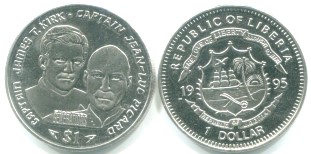
Star
Trek Captains James T. Kirk and Jean-Luc Picard are featured on this
1995 Liberian 1 Dollar coin. The coin was supposed to be
released as part of the merchandising connected with the Star Trek
Generations movie. Due to a problem connected with distribution rights,
the coin was never officially released in the United States. The movie
featured both Captain Kirk in The Original Star Trek television series
and Captain Piccard of the Star Trek Next Generation television
series. The movie attempted to serve as a connection between
the two series. The reverse of the 38.6mm copper-nickel coin depicts
the Liberian coat of arms that includes a sailing ship.
Item LR-TREK LIBERIA 1 DOLLAR 1995 STAR TREK
KM128 BU $9.75
THE COPPER PANDA
 Liberia
issued this copper 1 Dollar coin depicting a Panda eating bamboo in
1997 to commemorate the Association of Zoos and Aquariums (AZA) species
survival plan. It is a breeding and transfer program to
manage a genetically diverse, biologically sound population of some 300
endangered species in zoos and aquariums. The coin has
legends in both English and Chinese surrounding the Panda.
The obverse includes the Liberia coat of arms which includes a sailing
ship and a palm tree. The 32mm copper coin weighs 13.94
grams.
Liberia
issued this copper 1 Dollar coin depicting a Panda eating bamboo in
1997 to commemorate the Association of Zoos and Aquariums (AZA) species
survival plan. It is a breeding and transfer program to
manage a genetically diverse, biologically sound population of some 300
endangered species in zoos and aquariums. The coin has
legends in both English and Chinese surrounding the Panda.
The obverse includes the Liberia coat of arms which includes a sailing
ship and a palm tree. The 32mm copper coin weighs 13.94
grams.
Item
LR-PANDA LIBERIA 1 DOLLAR 1997 PANDA KM426
BU
$5.00
Item
LR-PANDAx5 5 of the above LIBERIA 1 DOLLAR
1997 PANDA KM426 BU
$15.00
RARE MALI 25 FRANCS

The
central African nation of Mali has issued few coins for
circulation. Its first coins for circulation were issued in
1961, shortly after achieving independence from
France. The next issue was not until the
mid-1970's, when this aluminum 25 Francs was released. Since
then no further coins have been released for
circulation. The 27mm coin has inscriptions on one side and a
sorghum plant on the other. Sorghum is an important food crop
for the improvished nation.
Item
ML-25F76 MALI 25 FRANCS 1976 KM12 UNC.$15.00
ONCE RARE
MAURITANIA
BANKNOTE IS NOW AVAILABLE
Until recently these banknotes from the west
African nation of Mauritania were difficult if not virtually impossible
for collectors to obtain. Some were not even been released
into circulation. They carried high catalog values or were
left unpriced. A hoard of these notes was recently released
making them available at reasonable prices - until the hoard is
disbursed.
Like all Mauritanian notes printed from 1974 until
2017 they carry a watermark of "the old man". The old man was
supposed to represent a generic wise, Mauritian man. Just
prior to visiting signing a contract with German security banknote
printer Giesecke & Devrient, the Governor of the Central Bank
purchased a picture by French artist Mytro Debard. It
included the portrait of a bearded old man. He so admired the
portrait that he asked the banknote printers to include it as a
watermark, without realizing it was a living person: Sidi Ethmane Ould
Mohamed Mahmoud Essemlaly, a Smalils tribe sharif.
We are pleased to offer the following
once rare Mauritian banknotes at very reasonable prices. The
red 1000 Ouguiya dated 1981 pictures the "old man" on the front. A
camel, field workers and ore processing facility are on the
back. The note was never released into circulation and until
now was extremely scarce.
Item
PM-MR-1000-OUG MAURITANIA 1000 OUGUIYA 1981
P3D UNC.
$7.00
MAURITANIA
SET INCLUDES BI-METALLIC COINS
This six coin set from the west African desert nation of Mauritania
includes two bi-metallics. The aluminum 1973 1/5 Ouguiya and the 2009
nickel-plated steel 1 Ouguiya were struck only a single year.
The 5, 10 and bi-metallic 20 Ouguiya are all dated 2009 and the
bi-metallic 50 Ouguiya is dated 2014. Mauritania has two
official languages, Arabic and French, so one side of their coins is in
Arabic with an AH date and the other side is in French with an AD
date. All but he 1/5 Ouguiya are magnetic.
Item
MR-SET6 MAURITANIA 6 COIN SET 1/5 - 50
OUGUIYA 1973-2014 UNC.
$18.00
WHEN A COMPANY
RAN A COUNTRY - THE
MOZAMBIQUE COMPANY

The
1885 Congress of Berlin carved up Africa, granting various European
nations control over of the continent. The boundaries that
were set in the conference still make up most of the national
boundaries in Africa today. Portugal was granted control over
Mozambique; however it did not have the economic or military resources
to control the vast territory. In 1891 it granted The
Mozambique Company (Companhia de Moçambique) a 50 year concession over
the central region of Mozambique. The Company was given
almost complete control over the region, including the right
to exploit resources, collect taxes and require the natives to engage
in forced labor. It ran the Post Offices and issued its own
currency. It developed the port of Beira and built a railroad
to the landlocked British colonies of
Rhodesia
and Nyasaland. However
it did not have the financial resources needed to develop the rest of
its territory and often failed to meet its obligations to the
Portuguese government. Most of its income came from its
ability to tax and its power to use conscripted labor on its
plantations. Because of the company's poor
performance and
changes in the Portuguese government, the company's
concession
was not renewed when it expired in 1942. The Portuguese
Government assumed direct control of the region. The
currency
issued by the Company was recalled and punch
cancelled. From the
Mozambique Company we have the 20 Centavos note dated November 25,
1933 . The note is punch-cancelled "PAGO
5.11.1942" (PAID November 5, 1942), which was shortly after
the
Company lost its concession. The note wass were printed in
London by Bradbury, Wilkinson & Co. It is a
fascinating note from a private company that was given control over a
nation.
Item
PM-MZ-R20C MOZAMBIQUE COMPANY 20
CENTAVOS BANKNOTE 1933 PR29 AU-UNC.-cancelled
$12.00
LAST
COIN OF PORTUGUESE MOZAMBIQUE

This
1974 bronze 20 Centavos was one of the last coins issued by
Portugal for its colony of Mozambique. The following year Mozambique
was granted independence. The 16mm coin depicts the arms of
Portuguese Mozambique on one side and the denomination on the
other.
Item
MZ-20c
PORTUGUESE MOZAMBIQUE 20 CENTAVOS 1974 KM88 BU
$3.00
NAMIBIA 60 DOLLAR
BANKNOTE HONORS PRESIDENT'S 60 YEARS OF SERVICE

In 2025 Namibia issued a circulating polymer 60 Dollar banknote
honoring Dr. Hage Gottfried Geingob, who died in 2024. The 60
Dollar note commemorates his 60 years of "service and steadfast
dedication to Namibia's democracy, economic progress, and social
inclusion". He was country's first prime minister from 1990
to 2002, and again from 2012 to 2015. He was the Minister of
Trade and Industry from 2008 until 2012 and President of Namibia from
2015 until his death in 2024. The front of the note features
his portrait. Behind him is a faint image of the Constituent
Assembly of 1990 that drafted Namibia's constitution. Also
included is a SPARK image of the Bank of Namibia logo and two clear
windows, one featuring the facade of the Independence Memorial Museum
in Windhoek, the other features the Geingob's face and the number
"60". To assist the blind there is a circle of raised dots at
the upper right. Geingob was an avid soccer fan, so the back
features him holding a soccer trophy. Also on the back are
wind turbines, a hydrogen tank, biomass and solar panels. It
is an unusual denomination for a circulating banknote.
Item
PM-NA-$60 NAMIBIA 60 DOLLAR BANKNOTE, 2025
UNC.
$12.00
NIGER SILVER ABOLITION
OF SLAVERY PATTERN SILVEFR COIN
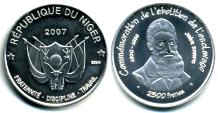
This
2007 unofficial 2500 Franc pattern was issued for Niger to commemorate
the 100th Anniversary of Great Britain outlawing slavery. The
obverse depicts John Brown. Brown was a radical American abolitionist
who led several violent anti-slavery confrontations in Bleeding Kansas
uprisings in the late 1850's. In 1859 he led a raid on the
Federal Amory in Harper's Ferry, Virginia hoping to spark a widespread
slave revolt. He was captured and hanged. The arms of Niger
is on the reverse. The 27.3mm coin is 1/4 troy ounce of .999 silver and
has a mintage of only 850 pieces.
Item
NE-SILVER NIGER SILVER 2500 FRANCS JOHN BROWN
2007 Br.E12 BU $45.00
2006
COIN SET FROM
NIGERIA
INCLUDES BI-METALLICS

In 2006 Nigeria issued
three new
coins: a 50 Kobo, a bimetallic 1 Naira and a bimetallic 2
Naira
dated 2006. The 2 Naira pictures the national assembly
building.
The 1 Naira portrays Herbert Maculay, one of the leaders of the
Nigerian independence movement. Ears of corn are on the 50
Kobo. The coins are Uncirculated, however there may be a few
minor spots.
Item
NG-SET06 NIGERIA 3 COIN SET 50 KOBO - 2 NAIRA
2006, UNC. $7.50
SCARCE PORTUGUESE
GUINEA
COIN
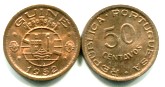
Portuguese
Guinea, located on the west coast of Africa, was discovered by Portugal
in 1446. It was a desolate outpost of the Portuguese
Empire. During its early years, the colonies chief export was
slaves destined for Brazil. After many years of neglect by
Portugal, it was granted independence in 1974 and became the nation of
Guinea-Bisseau. In 1952 Portugal struck the bronze 50
Centavos. One side bears the arms of Portuguese Guinea, the
other side has the arms of Portugal. The coin is Uncirculated.
Item
PORTGW-50C PORTUGUESE GUINEA 50
CENTAVOS 1952 KM8 UNC.
$8.00
DANCING
ELEPHANTS
FROM RHODESIA & NYASALAND
Great
Britain issued a joint coinage for their African colonies of Rhodesia
and Nyasaland, which are now the independent countries of
Zambia,
Malawi and
Zimbabwe.
The 1957 Rhodesia and Nysaland bronze bronze 1962
penny features a pair of elephants that appear to be dancing!
Both coins are made with a center hole. The
reverses
have the name of the colonies, denomination and date.
Item
R+N-1P RHODESIA &
NYASALAND 1 PENNY 1962 KM2 UNC.
$5.00
LION
ON
SCARCE, SHORT-LIVED COIN OF RWANDA-BURUNDI

After
Belgian Congo gained its independence in 1960, Belgium issued a coin
for what was left of its African territories: Rwanda and
Burundi. Only a single coin type was issued for the
joint
territory of Rwanda-Burundi: a brass 1 Franc. This brass 1961
brass 1 Franc coin features a walking lion on one side. The
other
has the names of the territories and the
denomination. In 1962 Rwanda and
Burundi were both
granted independence
Item
RWBU-1F RWANDA-BURUNDI 1 FRANC 1961 KM1
AU-UNC. $6.00
SCARCE BI-METALLIC
COINS
OF SAHARAWI


The
Saharawi Arab Democratic Republic, also known as Saharaui, is what used
to be the Spanish Sahara or Western Sahara. In 2004 Saharawi
issued
two bi-metallic 500 Peseta coins. One coin features a cute
pair
of
Fennecs, a long eared desert fox that is native to Saharawi. The other
commemorates the 28th anniversary of nation’s independence (though in
reality it is largely controlled by Morocco) and features a map of the
country. The obverse of both coins features the arms of
Saharawi,
which includes a pair of rifles. The coins are 26mm in
diameter
and
have a mintage of only 5000 pieces each.
Item
EH-FEN SAHARAWI 500 PESETAS 2004 FENNEC FOXES
Br.X51 UNC. $15.00
Item
EH-IND SAHARAWI 500 PESETAS 2004 INDEPENDENCE
Br.X52 UNC. $15.00
SAHARAWI
ARAB DEMOCRATIC REPUBLIC 2010 BI-METALLIC HONORS ARAB CULTURE

This
2010 dated bi-metal 500 Peseta coin of the Saharawi Arab Democratic
Republic honors Arab culture. The coin was issued in
conjunction with the Namur Expo in 2010. One side depicts
the national arms which feature a pair of crossed rifles
holding flags. The other depicts traditional Arab
hospitality, with one man preparing tea over a small fire while the
other plays a flute. Saharawi, formerly known as Spanish
Sahara, declared independence in 1976, however Morocco controls most of
its territory. The 26mm coin has a mintage of only 2500
pieces and is Uncirculated.
Item
EH-ARAB SAHARAWI 500 PESETAS 2010 BIMETAL
UNC.
$9.75
AFRICAN ANIMALS
ON 2020
SAHRAWI COIN SET
The Sahrawi Arab Democratic Republic, also known as Saharaui, or
Western Sahara, is what used to be the Spanish Sahara. Though it
declared independence from Spain in 1975, Morocco also claims the
region and currently controls about 80% of the territory.
This non-circulating 5-coin 2020 dated set of the Saharawi Arab
Democratic Republic features African wildlife. The
1 Pesesta depicts a Black-collared lovebird. An African
Buffalo is on the 5 Peseta. A lion is on the 10
Peseta. Th 25 Peseta features a hippopotamus. The 50 Peseta
portrays a Gorilla. The obverse of all the coins
depict the national arms, which features a pair of crossed rifles
holding flags. The 1 Peseta is aluminum, the others are
nickel-plated steel.
Item
EH-SET20
SAHRAWI 5 COIN SET 1-50 PESETAS WILDLIFE 2020 UNC.
$19.95
2022 SIERRA LEONE
COINS FEATURES
MUSICIANS AND THEIR INSTRUMENTS
In July 2022 Sierra Leone did a 1000 to 1 currency revaluation and
introduced a new series of coins. The coins feature popular
Sierra Leonian musicians on one side and their instrument on the
other. Sierra Leone is the only country that highlights
musicians on all their circulating coins. I suspect the
designs are a lot more popular with the public than live dictators or
dead politicians. The bi-metallic 50 Cents features accordionist and
singer Salia Koroma. The 10-sided, bi-metallic 25 Cents
depicts blind musician Bassie Sorie Kondi wearing sunglasses and a
Kalimba. The 8-sided 10 Cents depicts Sooliman Ernest Rogers,
a highlife and palm wine musician and guitarist and a
guitar. The scalloped edged 5 Cents pictures Jazz
and Afropop musician Israel Olorunfeh Cole, popularly known as Dr.
Oloh, along with a traditional Djembe drum. Singer Sullay Abu
Bakarr and a microphone are on the 1 Cent coin.
Item
SL-SET22 SIERRA LEONE 5 COIN SET 1-50 CENTS
2022 KM503-507 UNC.
$15.00
500th ANNIVERSARY
ST. PETER'S
BASILICA

The
500th anniversary of the laying the foundation stone of St. Peter's
Basilica in Rome is commemorated on this 2006 copper-nickel 1 Dollar
coin from Sierra Leone. The coin depicts the
basilica framed by two angels with Pope Benedict XVI and St. Peter in
the background. Architect Donato Bramante and a stonecutter
are in the foreground. It is built over the grave of St. Peter and is
considered the largest most important church of the Catholic
faith. It was started in in 1506 but not completed until 120
years later in 1626, after undergoing numerous design changes during
its construction. The 38.6mm
coin features the Sierra Leone coat of arms on the obverse.
Item SL-PETER06 SIERRA LEONE 1 DOLLAR 2006
ST. PETER'S BASILICA KM403 BU $7.50
AFRICAN
WILDLIFE COINS
FROM SIERRA LEONE
These beautiful coins from Sierra Leone feature African wildlife on one
side and depict the country’s coat of arms on the other. The
38.6mm copper-nickel coins are denominated 1 Dollar.
Item
SL-LION SIERRA LEONE 1 DOLLAR 2006 LION
KM311 BU $9.75
Item
SL-CAMEL SIERRA LEONE 1 DOLLAR 2006 CAMEL
KM32 BU $9.75
Item
SL-CHIMP SIERRA LEONE 1 DOLLAR 2006
CHIMPANZEE KM313 BU $9.75
Item
SL-IMPALA SIERRA LEONE 1 DOLLAR 2006 IMPALA
KM314 BU $9.75
Item
SL-ELEPAHANT SIERRA LEONE 1 DOLLAR 2007
ELEPHANT KM329 BU $9.75
THE WORLD’S FIRST
INTERACTIVE APP GAME COIN FEATURES ANGRY BIRDS

Angry
Birds is a popular, fun and addictive video game that can be played on
a wide variety of platforms. The game was first introduced in
2009. The original game and its revisions have over five
billion downloads across all platforms. Full length animated films
based on the game were released in 2016 and 2019.
In 2018 Sierra Leone released a multi-color “Angry Birds”
coin. According to Pobjoy Mint it is “the world’s first
interactive app game coin”. The design features Red and a special
Zapper code that allows you to enter the world of Angry Birds on your
mobile phone. The App allows you to interact with the characters and
permits you to take selfies with the enchanting characters.
The 38.6mm copper nickel coin is denominated 1 Dollar, has a mintage of
only 10,000 pieces and comes in a special pack. The Sierra
Leone coat of arms is on the reverse.
Item
SL-ANGRY SIERRA LEONE 1 DOLLAR 2018 ANGRY
BIRDS KM460 BU$19.95
BIG
5 AFRICAN WILDLIFE COINS FROM
SIERRA LEONE
Sierra Leone released a series of five copper-nickel 1 Dollar coins
depicting the Big Five African game animals. The term Big
Five refers to the Elephant, Lion, Rhino, Leopard and Cape Buffalo. The
term was originally used by big game hunters referring to the five
African animals that were most difficult to hunt on foot. Now
it is widely used by safari tour operators. This set of five
2019 1 Dollar coins features the head of each of the animals styled as
though it is an African mask. The African pattern is carried
over to the incused rim. The obverses of the coins depict arms of
Sierra Leone and the date. The coins are 38.6mm in
diameter. Each coin has a maximum mintage of only 10,000
pieces.
Item
SL-BIG5 SIERRA LEONE SET OF 5 WILDLIFE DOLLAR
COINS,
2019 BU
$49.75
WARLORD
NOTE OF
SOMALIA

In response to ongoing political and economic crisis's the Somali
government ordered new currency from De La Rue in 1990 in preparation
for a 100 to 1 currency revaluation. By the time the notes
were delivered in late 1991 the country had collapsed into anarchy as
various warlords attempted to establish dominance. The notes were
seized by warlord Ali Mahadi Mohammad's Mogadishu Northern
Forces. His troops were battling other warlords in the
"Banana War" over who got to collect the taxes on Somalia’s banana
exports. The front of multi-colored 1991 dated note shows a
man working a loom on the front. The back shows a banana
plant and a young person leading a donkey carrying three children. The
note has a watermark Sayyid Moḥammad Abdallah Hassan an early 20th
century religious and military leader who is considered "The Father of
Somali Nationalism". The British called him the "Mad Mullah".
The "N" in the denomination 50 N.Shillin was originally
meant to designate "New Shillin" as part of the currency revaluation,
but it was soon regarded as "North Shillin" because the notes
circulated in areas controlled by the Mogadishu Northern Forces.
Item
PM-SO-50SH SOMALIA 50 N.SHILLIN
WARLORD
NOTE 1991 PR2 UNC. $4.00
ATTRACTIVE SOMALIA
COIN SET
This attractive set includes fourcoins from the war-torn African
nation of Somalia. Included are the the 2000 dated 10
Shilling that features a
camel, the 2001 brass 25 Shillings depicting a soccer player,
the copper-nickel 2002 50 Shilling pictures
a
mandrill and the brass
2002 100
Shilling pictures the Queen of Sheba, who according to
legend,
ruled
the region in ancient times.
The arms of Somalia supported by two leopards is on the
obverse.
Item
SO-SET4 SOMALIA 4 COIN SET 10 - 100
SHILLINGS,
2000-2002, UNC. $4.00
SOMALILAND
COIN
SET
After the collapse of the
government of
Somalia in
the 1990's, the northern portion of the
country, once known as British Somaliland, declared independence.
Despite the lack of international recognition, it has one of the better
functioning
governments in Africa. This set contains
five coins
of Somaliland. The 1994 aluminum 1 Shilling depicting a
Somali
Pigeon was the first ever coin issued by Somaliland. Sir
Richard
R. Burton, the 19th century
explorer
and
writer who explored the area, is portrayed on the 2002 alumium 5
Shilling coin. A mother and
baby
Elephant is the 2005 aluminum 5 Shilling. A monkey is on
the brass 2002 dated 10
Shilling coin. A greyhound dog is on the 2002 stainless steel
20
Shilling
coin. The denomination is on the reverse of each
coin. It
is an interesting and attractive set from a successful but unrecognized
break-away republic.
Item
SOML-SET5 SOMILILAND 5 COIN SET, 1994-2005,
1-20 SHILLINGS, KM1-6 BU $4.50
OLD
UNCIRCULATED COINS OF
BRITISH SOUTH AFRICA
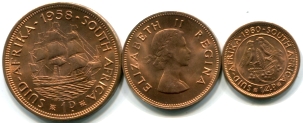
This
Brilliant Uncirculated three-coin set includes the bronze 1960
Farthing, 1957 Half Penny and 1958 Penny from South Africa.
They are some of the last coins of British South Africa. In
1961 the white minority government of South Africa declared itself a
republic and withdrew from the British Commonwealth. Young
Queen Elizabeth is on the obverse of all three coins. A pair
of Cape Sparrows perched on acacia branch is on the reverse of the
Farthing. The reverses of the Half and 1 Penny depict the
Dutch East India Company sailing ship Dromedaris. The ship,
under the command of Jan van Riebeeck, brought the first white settlers
to South Africa in 1652. All three coins have the name of the
country in both English and Afrikaans.
Item
ZA-SET3 SOUTH AFRICA 3 COIN SET:
FARTHING-PENNY, 1957-60, KM44-46 BU
$7.50
2019
SOUTH AFRICA CHILDREN & EDUCATION RIGHTS COINS
These two 2019 dated 2 Rand coins of South Africa feature two of the
basic human rights listed in South Africa's constitution: the rights of
children and the right to education. The constitution was
drafted shortly after the 1994 election which brought an end to the
country's Apartheid regime. It was formally promulgated in
1996. The right to education coin depicts a graduation cap, open book
and a children's alphabet block. The rights of children coin
depict four children from different ethnic groups. The arms
of South Africa is on the reverse of both of the 23mm nickel-plated
coins.
Item
ZA-2R-CHILD19 SOUTH AFRICA 2 RAND 2019
CHILDREN'S RIGHTS, UNC. $5.00
Item
ZA-2R-ED19 SOUTH AFRICA 2 RAND 2019 RIGHT TO
EDUCATION, UNC. $5.00
COMMEMORATIVE
BI-METALLIC 5 RAND FROM
SOUTH AFRICA


South Africa regularly issues circulating bi-metallic 5 Rand
coins. The 2015 issue commemorates the
200th Anniversary of the Griqua town coinage. The coins were
the first local currency of South Africa. The coin depicts
the obverse and reverse of the 1815 silver Griqua town 5
pence. Griqua town, now called Griekwastad is located in
Northern Cape Province of South Africa. It was settled
primarily by descendents of European male colonists and indigenous
Khoikhoi women who called themselves Bastaards. The London
Missionary Society established a mission there in 1805. The
Society thought the name was offensive and convinced them to change it
to Griqua, which was a corruption on the name of the native group that
once inhabited the area. The Griquas were
formidable traders and held formal trade fairs, though most commerce
was done by barter owing to a lack of money. Around 1815 the
London Missionary Society arranged for the Griqua coins to be struck
and shipped to South Africa. It is unclear how widely the coins
actually circulated. The 2014 issue commemorates
“20 Years of Freedom”. In 1994 South Africa implemented a new
constitution and held its first general election with universal
suffrage. The election was won by the African National
Congress, which has been in power ever since. The design
features a line of people waving a South African flag. The
coins all are 26mm with a brass center and copper-nickel
ring. The arms of South Africa and the name of the country in
one or two of its official languages is on the reverse.
Item
ZA-5R-15 SOUTH AFRICA 5 RAND 2015 GRIQUA TOWN
COINS UNC. $10.00
Item
ZA-5R-14 SOUTH AFRICA 5 RAND 2014 20th
ANNIVERSARY OF FREEDOM UNC. $10.00
SOUTH
SUDAN BANKNOTES FEATURE WILDLIFE
South Sudan is one of the youngest and poorest nations in the world.
After a long civil war, South Sudan finally gained its independence
from Sudan in July 2011. Since then, the nation has suffered from
multiple civil wars, floods and droughts. The South Sudan 2016 10 Pound
note depicts a pineapple and a Cape Buffalo cow and her calf on the
back. The back of the 2017 20 Pound note pictures an oil
derrick and a Oryx and her young. The front of the notes
picture and have a watermark of John Garing, a leader in the country's
independence movement.
Item
PM-SS-SET2 SOUTH SUDAN 10 & 20 POUND
NOTES 2016-17 P12 & 13 UNC. $4.00
CIVIL
WAR IN SUDAN


Civil War broke out in Sudan in April 2023 between the
paramilitary Rapid Support Forces (RSF) and the Sudanese Armed Forces
(SAF). The RSF was created by former president and
military strongman Omar al-Bashir in 2013 to crush uprisings in Darfur
and elsewhere. In 2017 it was al-Bashir made it an
"independent security force". In 2019 the Sudanese Armed
Forces joined with the RSF to overthrow al-Bashir and set up a
transitional civilian government. In October 2021 SAF and RSF
then overthrew the civilian government. Unable to come to an
agreement on power sharing, a civil war broke out between the two armed
forces, forcing thousands of civilians to flee for their
lives. This 2017 10 Pound note of Sudan pictures a baobab
(Tabaldia) tree, mountains and a camel. The back features the
Presidential Palace, which was damaged during the current civil
war. The note includes a watermark, holographic stripe and a
security thread. It is 155x69mm. The 2006 10 Piastres coin
depicts one of the famous Meroe Pyramids. The pyramids date
from between 720BC and 350AD. The copper-nickel coin is
20.4mm. It was struck at
the Khartoum mint for only a single year.
Item
PM-SD-10PND SUDAN 10 POUNDS NOTE 2017 P73
UNC. $3.00
Item
SD-10PIA SUDAN 10 PIASTRES COIN PYRAMID
2006 KM122 UNC. $3.00
SWAZI KING MSWATI III AND
HIS MANY WIVES
King Mswati III of Swaziland (now
Eswatini)
is one of the world’s last
absolute monarchs. He was appointed King in 1968 at age
18. The King wearing a traditional feather crown is
on the front of this Swaziland 10 Emalangeni note.
The back of the note features nine of his 15 wives dancing in the
Incwala ceremony, an annual month-long celebration of the
king. The note is printed on a hybrid paper and polymer
substrate with enhanced security features including a watermark of the
king.
Item
PM-SZ-10E SWAZILAND 10 EMALANGENI NOTE
2010 P36 UNC. $12.50
TANZANIA
COIN SET
FEATURES WILDLIFE 
This Tanzanian coin set includes the four denominations currently in
circulation. All four coins feature native wildlife on the
reverse
and a politician on the obverse. The reverse of the 500
Shillings features an African Buffalo along with a shifting image that
changes from the numeral "500" to "BOT" as the coin is
moved. A pair of lions is on the reverse
of the 200 Shillings. Both coins depict Sheikh Abeid Amani
Karume, the first President of Zanzibar on the obverse, and are dated
2014. Four running impalas are on the reverse of
the 100 Shillings. The obverse features Julius Nyerere, who
led Tanganyika to independence, and became the first President of
Tanzania after it was unified with Zanzibar. The
seven-sided 50 Shilingi features a rhinoceros and her calf.
An oxpecker bird sits atop the rhino. Ali Hassan Mwinyi, the
second President of Tanzania is on the obverse. The 100 and
50 Shillings are dated 2015.
Item S-TZ-SET4 TANZANIA 4 COIN SET 50 - 500
SHILLINGS,
2014-2015 UNC. $8.50
TOPLESS WOMAN ON
LOW MINTAGE BIMETALLIC TOGO COIN

This scarce unofficial bi-metallic 6000 CFA Francs coin of Togo
features a
topless Guin woman. The Guin are one of the major tribes in
Togo. The reverse features the head of an elephant and a map
of northern Africa. From the 16th to 18th Centuries Togo was
a major slave trading center, thus earning the name "Slave
Coast". It was claimed by Germany in 1884, transferred to
France after World War I, and became independent in 1960. The 2003
dated coin is 28mm in diameter, has a mintage of only 1,200 pieces and
a catalog value of $35.00
Item
TG-GUIN TOGO
6000 FRANCS 2003 GUIN WOMAN
BIMETAL Br.X 21 UNC $15.00
MULTI-SIDED
COINS FROM UGANDA

This attractive 1987 Uganda set includes four multi-sided
coins. The copper-plated steel 1 and 2 Shillings are 12-sided
coins. The
stainless steel 5 and 10 Shillings are seven sided. One side of the
coins features native plants and foodstuffs. The other has
the Ugandan arms which includes a
crested
crane and an oryx upholding a native shield. The coins were struck only
a single year. All coins are
Brilliant Uncirculated.
Item
UG-SET87
UGANDA 4 COIN SET, 1 - 10 SHILLINGS
1987 KM27-30 BU $3.50
UGANDA 1998 COIN SET FEATURE
NATIVE WILDLIFE
In 1998 Uganda introduced four new coins featuring native
wildlife. The thick, brass 500 Shillings features an East
African crowned crane. The 200 Shillings shows a Cichlid
fish. An African Bull is on the 100 Shillings and an antelope
is on the 50 Shillings. The obverses of all the coins depict
the Ugandan coat of arms which features a Ugandan Kob (a type of
antelope) and a Crested crane supporting a shield and spears.
Item
UG-SET98 UGANDA 4 COIN SET 50 - 500
SHILLINGS 1998 KM66-69 UNC.
$7.00
SCARCE
WEST AFRICAN
COINS


The West African States is a monetary union made up of former
French
colonies in Western Africa. They all use a common currency
and
the same coins in all the countries. Until now, the member
nations have issued few, if any coins under their own name.
In
2003 coins were issued for all seven members of the West African States
through the West African Development Bank.
Benin issued a nickel-plated steel 1500 Franc coin that
features
a buffalo and a bird. Burkina Faso, formerly known as Upper Volta,
released its first coin ever. It is a bi-metallic
(aluminum-bronze/copper-nickel) 6000 Franc coin that features birds and
a Rhinoceros. From Ivory Coast (Cote d'Ivoire) comes its first coin
since 1966. It is a nickel-plated steel 1500 Franc coin that
features a pair of elephants embracing each other with their trunks.
The nickel-plated steel 1500 Franc coin of Mali features a
Gazelle under a tree. Niger issued its first coin since 1968, and its
first ever non-precious metal coin. It is a brass-colored 3000 Francs
that features
a lion. Senegal issued its first ever non-precious metal
coin. It
is
an aluminum-bronze 3000 Franc coin that features a Galago, a small
primate that is commonly called a Bush Baby. Togo issued three
bi-metallic 6000
Franc coins. The first features a pair of embracing elephants. Another
features
a bare-breasted Guin woman. The third features Gnassingbe
Eyadema,
who has served as President of that nation continuously since 1967,
making
him the longest ruling leader in Africa. The coin lists the
dates
of
his Presidency as 1967 - 2003, as he had previously had announced he
would
retire in 2003. Like so many African rulars, he decided not
to
retire
after all. (suprise, suprise!).
The coins have a mintage of only 1200 pieces each.
As might
be expected, most of the coins were grabbed by government and bank
officials upon their release. Because these nations have
issued
so few coins, they are avidly sought after by one-coin-from-a-country
collectors, as well as animal collectors. We sold out of most
issues the first time we
offered these, however were lucky enough to find a new supply.
Item
BJ-1500 BENIN 1500 FRANCS 2003 BUFFALO
& BIRD Br.X40 UNC. $12.50
Item
BF-6000 BURKINA FASO 6000 FRANCS 2003 BIRDS
& RHINO BI-METAL Br.X1 UNC. out
Item
CI-1500 IVORY COAST 1500 FRANCS 2003
ELEPHANTS Br.X6 UNC. out
Item
ML-1500 MALI 1500 FRANCS 2003
GAZELLE,
Br.X17
UNC. $12.50
Item
NE-3000 NIGER 3000 FRANCS 2003 LION
Br.X12 AU-UNC. $15.00
Item
TG-ELEP TOGO
6000 FRANCS 2003 ELEPHANT BI-METAL Br.X20 UNC. $39.50
Item
TG-GUIN TOGO
6000 FRANCS 2003 GUIN WOMAN
BIMETAL Br.X21 UNC.
$15.00
Item TG-PRES
TOGO
6000 FRANCS 2003 PRESIDENT EYADEMA BI-METAL Br.X22
UNC. out
RARE ZAIRE COIN SET

In
1971 African dictator Mobuto Sese Seko changed the name of his nation
from the Congo Democratic Republic to Zaire. He also called the
monetary unit of his country Zaire. Zaire is a local name for
the Congo River. This three-coin set includes the
1, 5 and 10 Zaires. As might be expected, Mobuto is pictured on his
coins. After years of mismanagement he was overthrown in
1997, and the name of the country was restored to Congo Democratic
Republic. Each of the coins was struck only a single year, the 1 and 5
Zaires are dated 1987 while the 10 Zaires is dated 1988.
Item S-ZAIRE3
ZAIRE 1,5, & 10 ZAIRES 1987-88
KM13,14,19 UNC. $8.00
NEW
ZAMBIA BANKNOTES
Zambia released a new series of 2024 dated banknotes in
2025. The notes all feature an African Fish Eagle
on the front, along with numerous security devices including a map of
Zambia (in what appears to be a shopping bag) that changes from gold to
green, a windowed security thread, and a front/back registration
device. The green 10 Kwacha displays the Kariba Dam on the
Zambezi river located on the border of Zambia and Zimbabwe.
The back depicts two pangolins and Kabwelume Falls. The red
20 Kwacha includes a farm tractor on the front. Two antelope
and Chishimba Falls are on the back. The notes are printed on
a Durasafe composite substrate.
Item
PM-ZM-SET2 ZAMBIA 10 & 20 KWACHA
NOTES, 2024 UNC.
$7.00
RARE BLACK RHINO ON BIMETALLIC
ZIMBABWE COIN
 The
critically endangered Black Rhinoceros is featured on this bi-metallic
Zimbabwe 5 Dollar coin. Zimbabwe hosts one of the few remaining
significant populations of the Black Rhino. Though it is
referred to as black, its color varies from brown to gray.
The obverse depicts the Zimbabwe stone bird, which is the country's
national emblem. It has appeared on coins and banknotes of
Southern Rhodesia, Rhodesia and Zimbabwe since
1932. The original soapstone sculptures were found
in the ruins of the city of Great Zimbabwe and date from the 11th to
the 14th century. The 27.4mm coin has nickel-plated steel
center surrounded by a brass ring and is dated 2001 or 2002.
The
critically endangered Black Rhinoceros is featured on this bi-metallic
Zimbabwe 5 Dollar coin. Zimbabwe hosts one of the few remaining
significant populations of the Black Rhino. Though it is
referred to as black, its color varies from brown to gray.
The obverse depicts the Zimbabwe stone bird, which is the country's
national emblem. It has appeared on coins and banknotes of
Southern Rhodesia, Rhodesia and Zimbabwe since
1932. The original soapstone sculptures were found
in the ruins of the city of Great Zimbabwe and date from the 11th to
the 14th century. The 27.4mm coin has nickel-plated steel
center surrounded by a brass ring and is dated 2001 or 2002.
Item
ZW-5D-01 ZIMBABWE 5 DOLLARS 2001 KM13 BU
$6.00
Item
ZW-5D-02 ZIMBABWE 5 DOLLARS 2002 KM13 BU
$6.00
Item
ZW-5D-02x5 5 of the above ZIMBABWE 5 DOLLARS
2002 KM13 BU
$18.00
ZIMBABWE 2003 COIN
SET
In 2003 Zimbabwe
minted
two new
high denomination coins, a 10 Dollar coin picturing a water buffalo
and a 25 Dollar coin showing a group of soldiers.
By the
time
the
coins were designed and minted, ongoing inflation made them almost
worthless,
so they were not released to circulation at that time. In
August
2008 Zimbabwe revalued their currency for the second time by removing
10 zeros from the currency. As part of the 2008 revaluation,
the
2003
dated $10 coin (worth $100,000,000,000.00 of the old
currency)
and $25 (replaces $250,000,000,000.00 of the old currency) were finally
released. The coins however circulated only
very
briefly as inflation continued to increase and within a few weeks the
coins were again worthless.
Item
ZW-SET2 2 COIN SET 10 DOLLARS
& 25 DOLLARS 2003, KM14 & KM15 UNC.
$7.50
HIGH
VALUE ZIMBABWE
HYPERINFLATION NOTES
 In
2007 and 2008 Zimbabwe suffered from some of the world’s worst
hyperinflation. Prices would double every 24 hours.
This 12 note set includes the regular issue $1 million, $50 million,
$100 million $200 million, $500 Million, $1 billion, $5 billion, $10
billion, $20 billion and $50 billion notes. The notes depict
the Chiremba balancing rocks on the front and vignettes of Zimbabwe
life, wildlife and industry on the backs. Also included in
the set are the $100 million bearer cheque and $5 billion Agro-cheque
that circulated alongside the regular currency. The
denominations are both in numerals and words on all the notes. All
notes are dated 2008 and are well circulated.
In
2007 and 2008 Zimbabwe suffered from some of the world’s worst
hyperinflation. Prices would double every 24 hours.
This 12 note set includes the regular issue $1 million, $50 million,
$100 million $200 million, $500 Million, $1 billion, $5 billion, $10
billion, $20 billion and $50 billion notes. The notes depict
the Chiremba balancing rocks on the front and vignettes of Zimbabwe
life, wildlife and industry on the backs. Also included in
the set are the $100 million bearer cheque and $5 billion Agro-cheque
that circulated alongside the regular currency. The
denominations are both in numerals and words on all the notes. All
notes are dated 2008 and are well circulated.
Item
PM-ZW-SET12 SET OF 12 ZIMBABWE
BANKNOTES $1 MILLION - $50 BILLION 2008 CIRCULATED $19.95
Item
PM-ZW-SET12x5 5 of the above SETS OF 12
ZIMBABWE INFLATION NOTES (total of 60 notes) $95.00
NEW
ZIMBABWE CURRENCY
Despite the previous disastrous inflation brought on by issuing huge
quantities of unbacked currency, the Reserve Bank of Zimbabwe is again
issuing unbacked currency. In 2019 it released new 2 and 5
Dollar notes, followed by 10 and 20 Dollar notes in 2020, then 50 and
100
Dollar notes in 2021 (dated 2020). The government
unsuccessfully tried to
outlaw the use of foreign currencies in order to force the acceptance
of the Zimbabwe notes, but was forced to backtrack after government
employees refused to accept pay in their own government’s
currency. The notes all feature the Chiremba Balancing Rocks
on the front. The backs depict Zimbabwe scenes and wildlife.
Item
PM-ZW-SET6 ZIMBABWE 6 NOTE SET 2 DOLLARS TO
100 DOLLARS 2019-20 UNC. $27.50
ZIMBABWE
GOLD NOTES
In April 2024 Zimbabwe introduced a new currency, called Zimbabwe Gold
or ZiG, to replace the previous Zimbabwe dollar whose value was
severely diminished by inflation. It is the sixth currency introduced
by Zimbabwe since their independence in 1980. The ZiG is supposed to be
backed by gold and foreign reserves. Few Zimbabweans seem to believe
it. About 70% of all transactions in Zimbabwe are still done in U.S.
dollars. The government had promised that previous
currencies would be backed by bonds or reserves, however Zimbabwe
continued to issue far more currency than reserves, fueling massive
inflation. The 10 ZiG and 20 Zig notes have similar designs.
They feature the Chiremba balancing rocks on the front and a QR code on
the front. The back depicts gold pouring from
a crucible into an ingot mold atop a stack of gold bars. Also available
are banknotes from Zimbabwe's previous currencies.
Item
PM-ZW-10ZIG ZIMBABWE 10 ZIG 2024 BANKNOTE
UNC. $5.00
Item
PM-ZW-20ZIG ZIMBABWE 20 ZIG 2024 BANKNOTE
UNC. $10.00
2024 ZiG COINS FROM
ZIMBABWE
 In
April 2024 Zimbabwe introduced a
new currency, called Zimbabwe Gold or ZiG, to replace the previous
Zimbabwe dollar whose value was severely diminished by inflation. It is
the sixth currency introduced by Zimbabwe since their independence in
1980. The ZiG is supposed to be backed by gold and foreign reserves,
however few Zimbabweans believe it. The first coins
released in this
series are the 1, 2 and 5 ZiG coins dated 2024. The
nickel-plated
steel coins all feature the stone Zimbabwe bird on the
obverse. A
Flame Lily flower is on the 1 ZiG. The tower in the ruins of
Great
Zimbabwe is on the 2 ZiG coin. Victoria Falls is on the 5 Zig
coin.
In
April 2024 Zimbabwe introduced a
new currency, called Zimbabwe Gold or ZiG, to replace the previous
Zimbabwe dollar whose value was severely diminished by inflation. It is
the sixth currency introduced by Zimbabwe since their independence in
1980. The ZiG is supposed to be backed by gold and foreign reserves,
however few Zimbabweans believe it. The first coins
released in this
series are the 1, 2 and 5 ZiG coins dated 2024. The
nickel-plated
steel coins all feature the stone Zimbabwe bird on the
obverse. A
Flame Lily flower is on the 1 ZiG. The tower in the ruins of
Great
Zimbabwe is on the 2 ZiG coin. Victoria Falls is on the 5 Zig
coin.
Item
ZW-ZIGSET ZIMBABWE 1, 2 & 5 ZiG COINS,
2024 UNC. $10.00
<--
PREVIOUS PAGE
NEXT PAGE -->


 This
unofficial 2026 10 Afro coin of the African Union features a lion on
the reverse and a women's face superimposed on a map of
Africa on the
obverse. It has legends in Swahili, English, French and
Portuguese.
The long term goals of the African Union include promoting sustainable
economic and social development, closer integration of the African
economies, visa free travel throughout the continent and a single
currency throughout Africa. The 40mm, eight-sided, silver
plated Proof
coin has a mintage of just 110 pieces.
This
unofficial 2026 10 Afro coin of the African Union features a lion on
the reverse and a women's face superimposed on a map of
Africa on the
obverse. It has legends in Swahili, English, French and
Portuguese.
The long term goals of the African Union include promoting sustainable
economic and social development, closer integration of the African
economies, visa free travel throughout the continent and a single
currency throughout Africa. The 40mm, eight-sided, silver
plated Proof
coin has a mintage of just 110 pieces.


 Portuguese
explorers reached Angola in 1484. Portugal established settlements and
trading posts along the coast in the 16th century. Much of
the trade consisted of exchanging manufactured European goods for
slaves from local slave traders then exporting the slaves to
Brazil. Though the slave trade was formally abolished in
Angola in 1836, it continued illegally for some years.
Portuguese control of Angola slowly extended inland in the 19th
century, though the boundaries were not finally delineated until the
1920's. A war for independence broke out in 1961 that
continued until independence was finally granted in
1975. Upon gaining independence a civil war erupted
in Angola between various pro-independence factions, which continued
for another 27 years. This 1967 Portuguese Angola 2
1/2 Escudos was struck in Lisbon during Angola's war for Independence.
The 20mm copper-nickel coin features the coat of arms of Portuguese
Angola on one side and the and Portugal's national emblem on the
other.
Portuguese
explorers reached Angola in 1484. Portugal established settlements and
trading posts along the coast in the 16th century. Much of
the trade consisted of exchanging manufactured European goods for
slaves from local slave traders then exporting the slaves to
Brazil. Though the slave trade was formally abolished in
Angola in 1836, it continued illegally for some years.
Portuguese control of Angola slowly extended inland in the 19th
century, though the boundaries were not finally delineated until the
1920's. A war for independence broke out in 1961 that
continued until independence was finally granted in
1975. Upon gaining independence a civil war erupted
in Angola between various pro-independence factions, which continued
for another 27 years. This 1967 Portuguese Angola 2
1/2 Escudos was struck in Lisbon during Angola's war for Independence.
The 20mm copper-nickel coin features the coat of arms of Portuguese
Angola on one side and the and Portugal's national emblem on the
other.  The
Angolan civil war broke out immediately after the country was
granted independence from Portugal. Three factions that had
been
fighting for independence started fighting each other for control of
the nation. Fighting continued sporadically for 27 years
until a
lasting peace agreement was finally achieved in 2002. Angola
issued this commemorative 200 Kwanza coin in 2022 to celebrating 20
years of Peace and Reconciliation following the end of the civil wars
in 2002. The obverse depicts two people embracing each
other. The reverse features the denomination and a native
pattern. Within the last zero of the denomination is a latent
image that changes from "200" to "BNA" (National Bank of Angola) as the
coin is tilted. The 28.5mm nickel clad steel coin was struck
at the Moscow mint.
The
Angolan civil war broke out immediately after the country was
granted independence from Portugal. Three factions that had
been
fighting for independence started fighting each other for control of
the nation. Fighting continued sporadically for 27 years
until a
lasting peace agreement was finally achieved in 2002. Angola
issued this commemorative 200 Kwanza coin in 2022 to celebrating 20
years of Peace and Reconciliation following the end of the civil wars
in 2002. The obverse depicts two people embracing each
other. The reverse features the denomination and a native
pattern. Within the last zero of the denomination is a latent
image that changes from "200" to "BNA" (National Bank of Angola) as the
coin is tilted. The 28.5mm nickel clad steel coin was struck
at the Moscow mint.  This
unusual coin of Benin is denominated in
three different currencies! The coin is denominated in the
local currency: 1500 CFA Francs, a common currency used by a number of
African nations that were once French colonies. More unusual
is that the coin is also denominated as 2.30 Euros and 3.45 Swiss
Francs. The 2005 coin was issued to honor (and sell at) the
2005 coin fairs in Basel, Switzerland and Piacenza, Italy. The coin
features a map of Europe highlighting the 25 members of the European
Union plus Switzerland one one side, and a map of Africa on the
other. The coin has a mintage of only 2005 pieces.
This
unusual coin of Benin is denominated in
three different currencies! The coin is denominated in the
local currency: 1500 CFA Francs, a common currency used by a number of
African nations that were once French colonies. More unusual
is that the coin is also denominated as 2.30 Euros and 3.45 Swiss
Francs. The 2005 coin was issued to honor (and sell at) the
2005 coin fairs in Basel, Switzerland and Piacenza, Italy. The coin
features a map of Europe highlighting the 25 members of the European
Union plus Switzerland one one side, and a map of Africa on the
other. The coin has a mintage of only 2005 pieces.
 Burundi
is a small, landlocked nation in central Africa. Because it
does
not have a mint of its own, it rarely issues coins. The four
coin
set includes the most recent coins of Burundi, though some are decades
old. Included is the 2011 nickel-plated steel 50
Francs
depicting a drummer holding a
drum on his head. Drumming is an important part of Burundi’s
culture and their drummers have achieved worldwide fame. The
2011
nickel-plated steel 10 Francs depicts bunches of bananas.
Both coins have the name of the country and legends in three
languages on the obverse. The 1980 5 Francs and the 2003 1
Franc
both feature the national arms and are struck in aluminum.
Burundi
is a small, landlocked nation in central Africa. Because it
does
not have a mint of its own, it rarely issues coins. The four
coin
set includes the most recent coins of Burundi, though some are decades
old. Included is the 2011 nickel-plated steel 50
Francs
depicting a drummer holding a
drum on his head. Drumming is an important part of Burundi’s
culture and their drummers have achieved worldwide fame. The
2011
nickel-plated steel 10 Francs depicts bunches of bananas.
Both coins have the name of the country and legends in three
languages on the obverse. The 1980 5 Francs and the 2003 1
Franc
both feature the national arms and are struck in aluminum. 
 This
unofficial bi-metallic 4500 Franc coin was issued for
Cameroons shortly after the ascension of
Pope Benedict XVI in 2005. The coin features a terrible,
toothy
portrait of Pope Benedict XVI. It makes the Pope
look like
a vampire. A map of Africa and an elephant's head
is on the
reverse.
This
unofficial bi-metallic 4500 Franc coin was issued for
Cameroons shortly after the ascension of
Pope Benedict XVI in 2005. The coin features a terrible,
toothy
portrait of Pope Benedict XVI. It makes the Pope
look like
a vampire. A map of Africa and an elephant's head
is on the
reverse. Cape
Verde is a group of 10 volcanic islands off the coast of
Africa. They were uninhabited until settled by the Portuguese
in 1462. They remained a Portuguese colony until independence in 1975.
The 1982 10 and 20 Escudos feature the busts of two "heroes of
independence" who had little direct involvement with Cape Verde gaining
independence. The 10 Escudos depicts Eduardo
Mondlane. He was a profession of anthropology and history at
Syracuse University prior to returning to Mozambique to lead the
Mozambique Liberation Front (FRELIMO). He was assassinated in
1969. Domingos Ramos, who appears on the 20 Escudos, fought
against the Portuguese in Portuguese Guinea. The denomination
and national emblem is on the reverse of both copper-nickel coins.
Cape
Verde is a group of 10 volcanic islands off the coast of
Africa. They were uninhabited until settled by the Portuguese
in 1462. They remained a Portuguese colony until independence in 1975.
The 1982 10 and 20 Escudos feature the busts of two "heroes of
independence" who had little direct involvement with Cape Verde gaining
independence. The 10 Escudos depicts Eduardo
Mondlane. He was a profession of anthropology and history at
Syracuse University prior to returning to Mozambique to lead the
Mozambique Liberation Front (FRELIMO). He was assassinated in
1969. Domingos Ramos, who appears on the 20 Escudos, fought
against the Portuguese in Portuguese Guinea. The denomination
and national emblem is on the reverse of both copper-nickel coins. Cape
Verde is a group of ten islands located 350 miles (570 km.) off the
coast of Western Africa. It gained independence from Portugal
in 1975. To celebrate the 40th anniversary of independence,
and the 40th anniversary of its central bank it issued this circulating
28.5mm bi-metallic 250 Escudos dated 2015. One side,
commemorating 40 years of development and features a school teacher,
windmills, a family and other images. The other side
commemorates the 40th anniversary of Banco de Cabo Verde. It
includes the national arms and various monetary and financial symbols
(looks like the designer had fun with the wingdings fonts).
Cape
Verde is a group of ten islands located 350 miles (570 km.) off the
coast of Western Africa. It gained independence from Portugal
in 1975. To celebrate the 40th anniversary of independence,
and the 40th anniversary of its central bank it issued this circulating
28.5mm bi-metallic 250 Escudos dated 2015. One side,
commemorating 40 years of development and features a school teacher,
windmills, a family and other images. The other side
commemorates the 40th anniversary of Banco de Cabo Verde. It
includes the national arms and various monetary and financial symbols
(looks like the designer had fun with the wingdings fonts). 
 A
fierce
leopard, crouching on a tree limb and about to pounce, is featured on
this 1967 10 Sengi coin from the Democratic Republic of the
Congo. The 17mm aluminum coin has the date and denomination
on the obverse.
A
fierce
leopard, crouching on a tree limb and about to pounce, is featured on
this 1967 10 Sengi coin from the Democratic Republic of the
Congo. The 17mm aluminum coin has the date and denomination
on the obverse.  The
Great Sphinx at Giza is featured on the front of this Egyptian 1
Millieme. The back includes the denomination and date in
Arabic. The coin is double dated with both the AH date of
1354 and the AD date of 1954. It was one of the
first coins struck by the Republic of Egypt after the overthrow of King
Farouk in 1952. The aluminum-bronze coin is 16mm.
The
Great Sphinx at Giza is featured on the front of this Egyptian 1
Millieme. The back includes the denomination and date in
Arabic. The coin is double dated with both the AH date of
1354 and the AD date of 1954. It was one of the
first coins struck by the Republic of Egypt after the overthrow of King
Farouk in 1952. The aluminum-bronze coin is 16mm. Egypt
recently released a number of circulating commemorative coins in an
effort to bolster support of the government. The coins have a
common obverse which includes the name of the country in Arabic, the
denomination in Arabic and English and both the AD and AH
dates. The 1 Pound coins are 25mm bi-metallic with a
brass-plated steel center in a nickel-plated steel ring. The
50 Piastres are 23mm brass-plated steel coins.
Egypt
recently released a number of circulating commemorative coins in an
effort to bolster support of the government. The coins have a
common obverse which includes the name of the country in Arabic, the
denomination in Arabic and English and both the AD and AH
dates. The 1 Pound coins are 25mm bi-metallic with a
brass-plated steel center in a nickel-plated steel ring. The
50 Piastres are 23mm brass-plated steel coins.  The 69th anniversary of National Police Day
is commemorated on a 2021 1 Pound coin. Police Day is in
remembrance of the 50 police officers of the Ismaila Police Station
that were killed or wounded when the British attacked the police
station with tanks on January 25, 1952 after the police refused abandon
the station and hand over their weapons. January 25 was
declared a national holiday in 2009 by Egyptian President Hosni Mubarak
to recognize the efforts of Egyptian police to maintain security and
stability. On Police Day in 2011 widespread protests against police
brutality and corruption led to a revolution which overthrew President
Mubarak. The bi-metallic coin features a winged eagle emblem and the
Arabic numbers 69.
The 69th anniversary of National Police Day
is commemorated on a 2021 1 Pound coin. Police Day is in
remembrance of the 50 police officers of the Ismaila Police Station
that were killed or wounded when the British attacked the police
station with tanks on January 25, 1952 after the police refused abandon
the station and hand over their weapons. January 25 was
declared a national holiday in 2009 by Egyptian President Hosni Mubarak
to recognize the efforts of Egyptian police to maintain security and
stability. On Police Day in 2011 widespread protests against police
brutality and corruption led to a revolution which overthrew President
Mubarak. The bi-metallic coin features a winged eagle emblem and the
Arabic numbers 69.  Egyptian
Medical Teams are honored on 50 Piastre and 1 Pound
coins. The coins feature four doctors. In order to
avoid offending conservative Muslims, the doctors have no facial
features. The coin is triple dated, bearing the date 2020
beneath the doctors, and AD 2021 and AH 1442 on the obverse.
Egyptian
Medical Teams are honored on 50 Piastre and 1 Pound
coins. The coins feature four doctors. In order to
avoid offending conservative Muslims, the doctors have no facial
features. The coin is triple dated, bearing the date 2020
beneath the doctors, and AD 2021 and AH 1442 on the obverse. "Decent
Life" is an initiative of
Egyptian President Abdel Fattah El-Sisi's improve rural areas of
Egypt. The multi-year project, started in 2019, aims to
improve sewer, water, electricity, natural gas and internet access in
villages, improve housing, as well as health and education
projects. The Decent Life 50 Piastre and 1 Pound coins both
feature a female farmer, wheat ears, and the Decent Life emblem, which
looks like a smile in a box. The coins are dated 2021.
"Decent
Life" is an initiative of
Egyptian President Abdel Fattah El-Sisi's improve rural areas of
Egypt. The multi-year project, started in 2019, aims to
improve sewer, water, electricity, natural gas and internet access in
villages, improve housing, as well as health and education
projects. The Decent Life 50 Piastre and 1 Pound coins both
feature a female farmer, wheat ears, and the Decent Life emblem, which
looks like a smile in a box. The coins are dated 2021. 


 Gambia occupies a long (295 miles, 475km.), narrow (7 to 35 miles, 11
to 48km.) strip of land along the banks of the Gambia river in Western
Africa. The British purchased it in 1588 making it the first possession
in what was to become Britain's once vast African empire. It
was granted
independence in 1970. In 1998, its newly elected
government introduced a new series of coins featuring
the nations coat-of-arms on one side. The other side featured important
cultural items for this small African nation. The bronze 1 Butut
features the nations chief export: peanuts. A native sailboat is on the
5 Bututs. The 10 Bututs shows a native partridge. An oil palm is on the
25 Bututs. It is an attractive, yet inexpensive coin set.
Gambia occupies a long (295 miles, 475km.), narrow (7 to 35 miles, 11
to 48km.) strip of land along the banks of the Gambia river in Western
Africa. The British purchased it in 1588 making it the first possession
in what was to become Britain's once vast African empire. It
was granted
independence in 1970. In 1998, its newly elected
government introduced a new series of coins featuring
the nations coat-of-arms on one side. The other side featured important
cultural items for this small African nation. The bronze 1 Butut
features the nations chief export: peanuts. A native sailboat is on the
5 Bututs. The 10 Bututs shows a native partridge. An oil palm is on the
25 Bututs. It is an attractive, yet inexpensive coin set. This
attractive six-coin set from the west African nation of Ghana
includes the 1,5,10,20 and 50 Pesewas, 1 and 2 Cedis.
The Pesewa depicts the Adomi Bridge across the Volta
River. It was struck only a single year: 2007. A man blowing
a cow horn is on the 2016 5
Pesewas. The horn was used to communicate messages and is an
important element of Ghanan culture. The 2016 10 Pesewas
features
a pen and an open book that includes a map of Ghana and a
diamond. The 2016 20 Pesewas depicts a Cocoa pod.
Cocoa is
one of Ghana's chief exports. The 2020 50 Pesewas pictures a
market woman in a large hat. The scales of Justice are on the
bi-metallic 2022 1 Cedi. The name Cedi is derived from the Akan word
for a
cowrie shell, which was used as money until 1901. The
bi-metallic 2 Cedis features numerous advanced security devices,
including latent images on both sides and micro-lettering along the rim
of the reverse. The coin depicts Jubilee House in Acca, which
serves as the presidential palace. All seven coins feature the Ghana
coat of arms on the obverse.
This
attractive six-coin set from the west African nation of Ghana
includes the 1,5,10,20 and 50 Pesewas, 1 and 2 Cedis.
The Pesewa depicts the Adomi Bridge across the Volta
River. It was struck only a single year: 2007. A man blowing
a cow horn is on the 2016 5
Pesewas. The horn was used to communicate messages and is an
important element of Ghanan culture. The 2016 10 Pesewas
features
a pen and an open book that includes a map of Ghana and a
diamond. The 2016 20 Pesewas depicts a Cocoa pod.
Cocoa is
one of Ghana's chief exports. The 2020 50 Pesewas pictures a
market woman in a large hat. The scales of Justice are on the
bi-metallic 2022 1 Cedi. The name Cedi is derived from the Akan word
for a
cowrie shell, which was used as money until 1901. The
bi-metallic 2 Cedis features numerous advanced security devices,
including latent images on both sides and micro-lettering along the rim
of the reverse. The coin depicts Jubilee House in Acca, which
serves as the presidential palace. All seven coins feature the Ghana
coat of arms on the obverse. 


 Star
Trek Captains James T. Kirk and Jean-Luc Picard are featured on this
1995 Liberian 1 Dollar coin. The coin was supposed to be
released as part of the merchandising connected with the Star Trek
Generations movie. Due to a problem connected with distribution rights,
the coin was never officially released in the United States. The movie
featured both Captain Kirk in The Original Star Trek television series
and Captain Piccard of the Star Trek Next Generation television
series. The movie attempted to serve as a connection between
the two series. The reverse of the 38.6mm copper-nickel coin depicts
the Liberian coat of arms that includes a sailing ship.
Star
Trek Captains James T. Kirk and Jean-Luc Picard are featured on this
1995 Liberian 1 Dollar coin. The coin was supposed to be
released as part of the merchandising connected with the Star Trek
Generations movie. Due to a problem connected with distribution rights,
the coin was never officially released in the United States. The movie
featured both Captain Kirk in The Original Star Trek television series
and Captain Piccard of the Star Trek Next Generation television
series. The movie attempted to serve as a connection between
the two series. The reverse of the 38.6mm copper-nickel coin depicts
the Liberian coat of arms that includes a sailing ship. Liberia
issued this copper 1 Dollar coin depicting a Panda eating bamboo in
1997 to commemorate the Association of Zoos and Aquariums (AZA) species
survival plan. It is a breeding and transfer program to
manage a genetically diverse, biologically sound population of some 300
endangered species in zoos and aquariums. The coin has
legends in both English and Chinese surrounding the Panda.
The obverse includes the Liberia coat of arms which includes a sailing
ship and a palm tree. The 32mm copper coin weighs 13.94
grams.
Liberia
issued this copper 1 Dollar coin depicting a Panda eating bamboo in
1997 to commemorate the Association of Zoos and Aquariums (AZA) species
survival plan. It is a breeding and transfer program to
manage a genetically diverse, biologically sound population of some 300
endangered species in zoos and aquariums. The coin has
legends in both English and Chinese surrounding the Panda.
The obverse includes the Liberia coat of arms which includes a sailing
ship and a palm tree. The 32mm copper coin weighs 13.94
grams.  The
central African nation of Mali has issued few coins for
circulation. Its first coins for circulation were issued in
1961, shortly after achieving independence from
France. The next issue was not until the
mid-1970's, when this aluminum 25 Francs was released. Since
then no further coins have been released for
circulation. The 27mm coin has inscriptions on one side and a
sorghum plant on the other. Sorghum is an important food crop
for the improvished nation.
The
central African nation of Mali has issued few coins for
circulation. Its first coins for circulation were issued in
1961, shortly after achieving independence from
France. The next issue was not until the
mid-1970's, when this aluminum 25 Francs was released. Since
then no further coins have been released for
circulation. The 27mm coin has inscriptions on one side and a
sorghum plant on the other. Sorghum is an important food crop
for the improvished nation.

 The
1885 Congress of Berlin carved up Africa, granting various European
nations control over of the continent. The boundaries that
were set in the conference still make up most of the national
boundaries in Africa today. Portugal was granted control over
Mozambique; however it did not have the economic or military resources
to control the vast territory. In 1891 it granted The
Mozambique Company (Companhia de Moçambique) a 50 year concession over
the central region of Mozambique. The Company was given
almost complete control over the region, including the right
to exploit resources, collect taxes and require the natives to engage
in forced labor. It ran the Post Offices and issued its own
currency. It developed the port of Beira and built a railroad
to the landlocked British colonies of Rhodesia
and Nyasaland. However
it did not have the financial resources needed to develop the rest of
its territory and often failed to meet its obligations to the
Portuguese government. Most of its income came from its
ability to tax and its power to use conscripted labor on its
plantations. Because of the company's poor
performance and
changes in the Portuguese government, the company's
concession
was not renewed when it expired in 1942. The Portuguese
Government assumed direct control of the region. The
currency
issued by the Company was recalled and punch
cancelled. From the
Mozambique Company we have the 20 Centavos note dated November 25,
1933 . The note is punch-cancelled "PAGO
5.11.1942" (PAID November 5, 1942), which was shortly after
the
Company lost its concession. The note wass were printed in
London by Bradbury, Wilkinson & Co. It is a
fascinating note from a private company that was given control over a
nation.
The
1885 Congress of Berlin carved up Africa, granting various European
nations control over of the continent. The boundaries that
were set in the conference still make up most of the national
boundaries in Africa today. Portugal was granted control over
Mozambique; however it did not have the economic or military resources
to control the vast territory. In 1891 it granted The
Mozambique Company (Companhia de Moçambique) a 50 year concession over
the central region of Mozambique. The Company was given
almost complete control over the region, including the right
to exploit resources, collect taxes and require the natives to engage
in forced labor. It ran the Post Offices and issued its own
currency. It developed the port of Beira and built a railroad
to the landlocked British colonies of Rhodesia
and Nyasaland. However
it did not have the financial resources needed to develop the rest of
its territory and often failed to meet its obligations to the
Portuguese government. Most of its income came from its
ability to tax and its power to use conscripted labor on its
plantations. Because of the company's poor
performance and
changes in the Portuguese government, the company's
concession
was not renewed when it expired in 1942. The Portuguese
Government assumed direct control of the region. The
currency
issued by the Company was recalled and punch
cancelled. From the
Mozambique Company we have the 20 Centavos note dated November 25,
1933 . The note is punch-cancelled "PAGO
5.11.1942" (PAID November 5, 1942), which was shortly after
the
Company lost its concession. The note wass were printed in
London by Bradbury, Wilkinson & Co. It is a
fascinating note from a private company that was given control over a
nation.
 This
1974 bronze 20 Centavos was one of the last coins issued by
Portugal for its colony of Mozambique. The following year Mozambique
was granted independence. The 16mm coin depicts the arms of
Portuguese Mozambique on one side and the denomination on the
other.
This
1974 bronze 20 Centavos was one of the last coins issued by
Portugal for its colony of Mozambique. The following year Mozambique
was granted independence. The 16mm coin depicts the arms of
Portuguese Mozambique on one side and the denomination on the
other. 
 This
2007 unofficial 2500 Franc pattern was issued for Niger to commemorate
the 100th Anniversary of Great Britain outlawing slavery. The
obverse depicts John Brown. Brown was a radical American abolitionist
who led several violent anti-slavery confrontations in Bleeding Kansas
uprisings in the late 1850's. In 1859 he led a raid on the
Federal Amory in Harper's Ferry, Virginia hoping to spark a widespread
slave revolt. He was captured and hanged. The arms of Niger
is on the reverse. The 27.3mm coin is 1/4 troy ounce of .999 silver and
has a mintage of only 850 pieces.
This
2007 unofficial 2500 Franc pattern was issued for Niger to commemorate
the 100th Anniversary of Great Britain outlawing slavery. The
obverse depicts John Brown. Brown was a radical American abolitionist
who led several violent anti-slavery confrontations in Bleeding Kansas
uprisings in the late 1850's. In 1859 he led a raid on the
Federal Amory in Harper's Ferry, Virginia hoping to spark a widespread
slave revolt. He was captured and hanged. The arms of Niger
is on the reverse. The 27.3mm coin is 1/4 troy ounce of .999 silver and
has a mintage of only 850 pieces.  Portuguese
Guinea, located on the west coast of Africa, was discovered by Portugal
in 1446. It was a desolate outpost of the Portuguese
Empire. During its early years, the colonies chief export was
slaves destined for Brazil. After many years of neglect by
Portugal, it was granted independence in 1974 and became the nation of
Guinea-Bisseau. In 1952 Portugal struck the bronze 50
Centavos. One side bears the arms of Portuguese Guinea, the
other side has the arms of Portugal. The coin is Uncirculated.
Portuguese
Guinea, located on the west coast of Africa, was discovered by Portugal
in 1446. It was a desolate outpost of the Portuguese
Empire. During its early years, the colonies chief export was
slaves destined for Brazil. After many years of neglect by
Portugal, it was granted independence in 1974 and became the nation of
Guinea-Bisseau. In 1952 Portugal struck the bronze 50
Centavos. One side bears the arms of Portuguese Guinea, the
other side has the arms of Portugal. The coin is Uncirculated.
 After
Belgian Congo gained its independence in 1960, Belgium issued a coin
for what was left of its African territories: Rwanda and
Burundi. Only a single coin type was issued for the
joint
territory of Rwanda-Burundi: a brass 1 Franc. This brass 1961
brass 1 Franc coin features a walking lion on one side. The
other
has the names of the territories and the
denomination. In 1962 Rwanda and
Burundi were both
granted independence
After
Belgian Congo gained its independence in 1960, Belgium issued a coin
for what was left of its African territories: Rwanda and
Burundi. Only a single coin type was issued for the
joint
territory of Rwanda-Burundi: a brass 1 Franc. This brass 1961
brass 1 Franc coin features a walking lion on one side. The
other
has the names of the territories and the
denomination. In 1962 Rwanda and
Burundi were both
granted independence  This
2010 dated bi-metal 500 Peseta coin of the Saharawi Arab Democratic
Republic honors Arab culture. The coin was issued in
conjunction with the Namur Expo in 2010. One side depicts
the national arms which feature a pair of crossed rifles
holding flags. The other depicts traditional Arab
hospitality, with one man preparing tea over a small fire while the
other plays a flute. Saharawi, formerly known as Spanish
Sahara, declared independence in 1976, however Morocco controls most of
its territory. The 26mm coin has a mintage of only 2500
pieces and is Uncirculated.
This
2010 dated bi-metal 500 Peseta coin of the Saharawi Arab Democratic
Republic honors Arab culture. The coin was issued in
conjunction with the Namur Expo in 2010. One side depicts
the national arms which feature a pair of crossed rifles
holding flags. The other depicts traditional Arab
hospitality, with one man preparing tea over a small fire while the
other plays a flute. Saharawi, formerly known as Spanish
Sahara, declared independence in 1976, however Morocco controls most of
its territory. The 26mm coin has a mintage of only 2500
pieces and is Uncirculated.

 The
500th anniversary of the laying the foundation stone of St. Peter's
Basilica in Rome is commemorated on this 2006 copper-nickel 1 Dollar
coin from Sierra Leone. The coin depicts the
basilica framed by two angels with Pope Benedict XVI and St. Peter in
the background. Architect Donato Bramante and a stonecutter
are in the foreground. It is built over the grave of St. Peter and is
considered the largest most important church of the Catholic
faith. It was started in in 1506 but not completed until 120
years later in 1626, after undergoing numerous design changes during
its construction. The 38.6mm
coin features the Sierra Leone coat of arms on the obverse.
The
500th anniversary of the laying the foundation stone of St. Peter's
Basilica in Rome is commemorated on this 2006 copper-nickel 1 Dollar
coin from Sierra Leone. The coin depicts the
basilica framed by two angels with Pope Benedict XVI and St. Peter in
the background. Architect Donato Bramante and a stonecutter
are in the foreground. It is built over the grave of St. Peter and is
considered the largest most important church of the Catholic
faith. It was started in in 1506 but not completed until 120
years later in 1626, after undergoing numerous design changes during
its construction. The 38.6mm
coin features the Sierra Leone coat of arms on the obverse.
 Angry
Birds is a popular, fun and addictive video game that can be played on
a wide variety of platforms. The game was first introduced in
2009. The original game and its revisions have over five
billion downloads across all platforms. Full length animated films
based on the game were released in 2016 and 2019.
In 2018 Sierra Leone released a multi-color “Angry Birds”
coin. According to Pobjoy Mint it is “the world’s first
interactive app game coin”. The design features Red and a special
Zapper code that allows you to enter the world of Angry Birds on your
mobile phone. The App allows you to interact with the characters and
permits you to take selfies with the enchanting characters.
The 38.6mm copper nickel coin is denominated 1 Dollar, has a mintage of
only 10,000 pieces and comes in a special pack. The Sierra
Leone coat of arms is on the reverse.
Angry
Birds is a popular, fun and addictive video game that can be played on
a wide variety of platforms. The game was first introduced in
2009. The original game and its revisions have over five
billion downloads across all platforms. Full length animated films
based on the game were released in 2016 and 2019.
In 2018 Sierra Leone released a multi-color “Angry Birds”
coin. According to Pobjoy Mint it is “the world’s first
interactive app game coin”. The design features Red and a special
Zapper code that allows you to enter the world of Angry Birds on your
mobile phone. The App allows you to interact with the characters and
permits you to take selfies with the enchanting characters.
The 38.6mm copper nickel coin is denominated 1 Dollar, has a mintage of
only 10,000 pieces and comes in a special pack. The Sierra
Leone coat of arms is on the reverse.


 This
Brilliant Uncirculated three-coin set includes the bronze 1960
Farthing, 1957 Half Penny and 1958 Penny from South Africa.
They are some of the last coins of British South Africa. In
1961 the white minority government of South Africa declared itself a
republic and withdrew from the British Commonwealth. Young
Queen Elizabeth is on the obverse of all three coins. A pair
of Cape Sparrows perched on acacia branch is on the reverse of the
Farthing. The reverses of the Half and 1 Penny depict the
Dutch East India Company sailing ship Dromedaris. The ship,
under the command of Jan van Riebeeck, brought the first white settlers
to South Africa in 1652. All three coins have the name of the
country in both English and Afrikaans.
This
Brilliant Uncirculated three-coin set includes the bronze 1960
Farthing, 1957 Half Penny and 1958 Penny from South Africa.
They are some of the last coins of British South Africa. In
1961 the white minority government of South Africa declared itself a
republic and withdrew from the British Commonwealth. Young
Queen Elizabeth is on the obverse of all three coins. A pair
of Cape Sparrows perched on acacia branch is on the reverse of the
Farthing. The reverses of the Half and 1 Penny depict the
Dutch East India Company sailing ship Dromedaris. The ship,
under the command of Jan van Riebeeck, brought the first white settlers
to South Africa in 1652. All three coins have the name of the
country in both English and Afrikaans.


 This scarce unofficial bi-metallic 6000 CFA Francs coin of Togo
features a
topless Guin woman. The Guin are one of the major tribes in
Togo. The reverse features the head of an elephant and a map
of northern Africa. From the 16th to 18th Centuries Togo was
a major slave trading center, thus earning the name "Slave
Coast". It was claimed by Germany in 1884, transferred to
France after World War I, and became independent in 1960. The 2003
dated coin is 28mm in diameter, has a mintage of only 1,200 pieces and
a catalog value of $35.00
This scarce unofficial bi-metallic 6000 CFA Francs coin of Togo
features a
topless Guin woman. The Guin are one of the major tribes in
Togo. The reverse features the head of an elephant and a map
of northern Africa. From the 16th to 18th Centuries Togo was
a major slave trading center, thus earning the name "Slave
Coast". It was claimed by Germany in 1884, transferred to
France after World War I, and became independent in 1960. The 2003
dated coin is 28mm in diameter, has a mintage of only 1,200 pieces and
a catalog value of $35.00

 In
1971 African dictator Mobuto Sese Seko changed the name of his nation
from the Congo Democratic Republic to Zaire. He also called the
monetary unit of his country Zaire. Zaire is a local name for
the Congo River. This three-coin set includes the
1, 5 and 10 Zaires. As might be expected, Mobuto is pictured on his
coins. After years of mismanagement he was overthrown in
1997, and the name of the country was restored to Congo Democratic
Republic. Each of the coins was struck only a single year, the 1 and 5
Zaires are dated 1987 while the 10 Zaires is dated 1988.
In
1971 African dictator Mobuto Sese Seko changed the name of his nation
from the Congo Democratic Republic to Zaire. He also called the
monetary unit of his country Zaire. Zaire is a local name for
the Congo River. This three-coin set includes the
1, 5 and 10 Zaires. As might be expected, Mobuto is pictured on his
coins. After years of mismanagement he was overthrown in
1997, and the name of the country was restored to Congo Democratic
Republic. Each of the coins was struck only a single year, the 1 and 5
Zaires are dated 1987 while the 10 Zaires is dated 1988. 

 The
critically endangered Black Rhinoceros is featured on this bi-metallic
Zimbabwe 5 Dollar coin. Zimbabwe hosts one of the few remaining
significant populations of the Black Rhino. Though it is
referred to as black, its color varies from brown to gray.
The obverse depicts the Zimbabwe stone bird, which is the country's
national emblem. It has appeared on coins and banknotes of
Southern Rhodesia, Rhodesia and Zimbabwe since
1932. The original soapstone sculptures were found
in the ruins of the city of Great Zimbabwe and date from the 11th to
the 14th century. The 27.4mm coin has nickel-plated steel
center surrounded by a brass ring and is dated 2001 or 2002.
The
critically endangered Black Rhinoceros is featured on this bi-metallic
Zimbabwe 5 Dollar coin. Zimbabwe hosts one of the few remaining
significant populations of the Black Rhino. Though it is
referred to as black, its color varies from brown to gray.
The obverse depicts the Zimbabwe stone bird, which is the country's
national emblem. It has appeared on coins and banknotes of
Southern Rhodesia, Rhodesia and Zimbabwe since
1932. The original soapstone sculptures were found
in the ruins of the city of Great Zimbabwe and date from the 11th to
the 14th century. The 27.4mm coin has nickel-plated steel
center surrounded by a brass ring and is dated 2001 or 2002.
 In
2007 and 2008 Zimbabwe suffered from some of the world’s worst
hyperinflation. Prices would double every 24 hours.
This 12 note set includes the regular issue $1 million, $50 million,
$100 million $200 million, $500 Million, $1 billion, $5 billion, $10
billion, $20 billion and $50 billion notes. The notes depict
the Chiremba balancing rocks on the front and vignettes of Zimbabwe
life, wildlife and industry on the backs. Also included in
the set are the $100 million bearer cheque and $5 billion Agro-cheque
that circulated alongside the regular currency. The
denominations are both in numerals and words on all the notes. All
notes are dated 2008 and are well circulated.
In
2007 and 2008 Zimbabwe suffered from some of the world’s worst
hyperinflation. Prices would double every 24 hours.
This 12 note set includes the regular issue $1 million, $50 million,
$100 million $200 million, $500 Million, $1 billion, $5 billion, $10
billion, $20 billion and $50 billion notes. The notes depict
the Chiremba balancing rocks on the front and vignettes of Zimbabwe
life, wildlife and industry on the backs. Also included in
the set are the $100 million bearer cheque and $5 billion Agro-cheque
that circulated alongside the regular currency. The
denominations are both in numerals and words on all the notes. All
notes are dated 2008 and are well circulated. 


 In
April 2024 Zimbabwe introduced a
new currency, called Zimbabwe Gold or ZiG, to replace the previous
Zimbabwe dollar whose value was severely diminished by inflation. It is
the sixth currency introduced by Zimbabwe since their independence in
1980. The ZiG is supposed to be backed by gold and foreign reserves,
however few Zimbabweans believe it. The first coins
released in this
series are the 1, 2 and 5 ZiG coins dated 2024. The
nickel-plated
steel coins all feature the stone Zimbabwe bird on the
obverse. A
Flame Lily flower is on the 1 ZiG. The tower in the ruins of
Great
Zimbabwe is on the 2 ZiG coin. Victoria Falls is on the 5 Zig
coin.
In
April 2024 Zimbabwe introduced a
new currency, called Zimbabwe Gold or ZiG, to replace the previous
Zimbabwe dollar whose value was severely diminished by inflation. It is
the sixth currency introduced by Zimbabwe since their independence in
1980. The ZiG is supposed to be backed by gold and foreign reserves,
however few Zimbabweans believe it. The first coins
released in this
series are the 1, 2 and 5 ZiG coins dated 2024. The
nickel-plated
steel coins all feature the stone Zimbabwe bird on the
obverse. A
Flame Lily flower is on the 1 ZiG. The tower in the ruins of
Great
Zimbabwe is on the 2 ZiG coin. Victoria Falls is on the 5 Zig
coin.