COINS &
CURRENCY
OF WORLD WAR II
A selection of money associated
with
World War 2
NAZI
GERMANY SILVER COINS

These four silver coins serve as a memento of the horrors of the Third
Reich. The 2 Reichsmark was issued from 1936 to 1939. It pictures Paul
von Hindenburg on one side and an eagle holding a wreathed swastika on
the other. It is 25mm in diameter and contains .1607 troy ounces of
silver. Nazi Germany used three different designs on their
regular
issue 5 Reichsmark coins. The first pictured the Potsdam Military
Church, also called the Potsdam Garrison Church, on one side and an
eagle and two small swastikas on the other. It was struck only from
1934 to 1935. The Church was built by Prussian King Friedrich Wilhelm I
between 1730 and 1735. Adolf Hitler was sworn in a Chancellor of
Germany by Paul von Hindenburg at the Church in 1933. It burned down in
the fires caused by the Allied bombing in 1945. The second type was
struck during only during the last part of 1935 and the first part of
1936. It pictured Paul von Hindenburg on one side and an eagle on the
other. Starting in 1936 the Eagle reverse was replaced with an eagle
holding a wreathed swastika, similar to the 2 Reichsmark. The Eagle and
Swastika 5 Reichsmark was struck from 1936 to 1939. The silver 5
Reichsmark coins are each 29mm in diameter and contains .4016 troy
ounces of silver. Because of the war, no Nazi silver coins were struck
after 1939. Coins grade Very Fine.
Item
DE-93 NAZI GERMANY SILVER 2 REICHSMARK
HINDENBURG/SWASTIKA
1936-39 KM93 VF
$24.00
Item
DE-83 NAZI
GERMANY SILVER 5 REICHSMARK MILITARY CHURCH
1934-35 KM83 VF
$49.75
Item DE-83x5 5 of the
NAZI
GERMANY SILVER 5
REICHSMARK MILITARY CHURCH 1934-35 KM83 VF $240.00
Item
DE-86 NAZI
GERMANY SILVER 5 REICHSMARK HINDENBURG/EAGLE
1935-36 KM86 VF
$50.00
Item
DE-94 NAZI
GERMANY SILVER 5 REICHSMARK
HINDENBURG/SWASTIKA
1936-39 KM94 AU-UNC. $75.00
NAZI
GERMAN 8 COIN SET 
This set consists of the eight lower denominations of Nazi German coins
each showing the eagle and swastika. The 1937-1939 issues include the
1, 2, 5 and 10 Reichspfennig made from copper or aluminum-bronze
alloys. In 1939 an aluminum 50 Reichspfennig with the Eagle and
Swastika was introduced, and was
produced until 1944. In 1940 the 1, 5 and 10 Reichspfennig
were switched to zinc and the 2 Reichspfennig was discontinued due to
the war. All eight coins grade VF or better, though the zinc coins may
show some spots as zinc spots very easily. The coins all feature the
denomination on one side and an eagle holding a swastika on the other.
Item
DE-NAZISET8 NAZI GERMAN 8 COIN SET 1- 50
REICHSPFENNIG, 1937-1944 VF $23.00
NAZI
GERMAN 14 COIN
SET

This 14 coin set includes the regular issue coins of Nazi
Germany listed above. Included are the following coins: The bronze 1
and 2
Reichspfennig issued from 1936 to 1940 with an eagle and swastika. The
aluminum-bronze (brass) 5 and 10 Reichspfennig issued from 1936 to 1939
with an eagle and swastika. The aluminum 50 Reichspfennig
picturing an eagle, which was dated only one year, 1935. The nickel 1
Reichsmark with an eagle which was issued from 1933 to 1939. Because
nickel was a critical war material, most were melted during the
War. The silver 5 Reichmark issued in 1934 and 1935 pictures
the Potsdam Garrison Church where Hitler was sworn into office on one
side and an eagle and two small swastikas on the other. Paul
von Hindenburg and an Eagle are on the silver 5 Reichsmark dated 1935
and 1936. The silver 2 Reichsmark and 5 Reichsmark
dating from 1936 to 1939 pictures Hindenburg on one side and an eagle
holding a swastika during the other. Because of
World War II, the only coins issued after 1940 were the zinc 1, 5 and
10 Reichspfennig, which depict an eagle holding a swastika. The coins
grade Very Fine or better, though the zinc coins may have
some spots. Because of the difficulty in obtaining all 14 coins at one
time, I rarely am able to offer this historic set.
(Note: this set includes the coins from Nazi set of 4 silver
coins and the Nazi 8 coin set listed above, plus the aluminum 1935 50
Reichspfennig which was issued that single year, and the scarce nickel
1 Reichsmark)
Item
DE-NAZISET14 NAZI GERMAN 14 COIN SET 1
REICHSPFENNIG - 5 REICHSMARK 1933-44 $210.00
NAZI GERMAN 50
REICHSPFENNIG COINS PREPARE FOR WAR
Nazi Germany issued four types of 50 Reichspfennig coins. With World
War II about to begin, Nazi Germany instituted major changes to the 50
Reichspfennig coin in 1938 and 1939. The Nazis continued to
mint the 22mm nickel 50 Reichspfennig that had been introduced in 1927
during the Weimar regime until sometime in 1938. The coin features the
German eagle on one side and the denomination on the other. In 1938
they introduced a new version of the nickel 50 Reichspfennig which
featured the Eagle holding a swastika in an oak wreath. The
coin was struck only two years, 1938 and 1939. Few were ever
released into circulation, making it by far the rarest Nazi German
regular issue coin. In 1939 Germany decided it needed nickel
for its war effort. The nickel 50 Reichspfennig coins were quickly
recalled and were demonetized in 1940. To replace the nickel coins
Germany released 22mm aluminum 50 Reichspfennig coin dated 1935. The
coin was struck in 1935 but had not been issued into circulation at
that time. It features the German Eagle without a swastika. Also, in
1939 a new aluminum 50 Reichspfennig with the Eagle holding a swastika
was introduced. It continued to be struck until
1944.
Item
DE-49 GERMANY NICKEL 50 REICHSPFENNIG
1927-1938 KM49 VF-XF $3.00
Item
DE-95 NAZI GERMANY NICKEL 50 REICHSPFENNIG
1938-39 KM95
XF-AU $80.00
Item
DE-87 NAZI GERMANY ALUMINUM 50 REICHSPFENNIG
1935 KM87
VF $5.00
Item
DE-96 NAZI GERMANY ALUMINUM 50 REICHSPFENNIG
1939-1944 KM96 VF $5.00
NAZI GERMAN
CURRENCY
The following notes were used in Nazi Germany throughout World War II
and remained legal tender until 1948. The notes bear two
dates: the date the note was first authorized, and the date the issuing
bank was authorized to issue currency. The Reichsbank was first
authorized to issue cufrrency on August 20, 1924. Unlike
coins, the date is not
the year the note was printed. These Reichsbank notes were
supposedly backed by gold, but could not be redeemed for gold.
The
20 Reichsmark note
dated 1929 portrays Ernst Werner
Siemens, the 19th century
German industralist and inventor who founded the Siemens A.G. which has
expanded into a multi-national company producing a wide range products.
The back features
children holding tools and a worker carrying a
hammer. It has a watermark of Siemans at the left
and
an embosed seal near the lower left corner. The note
continued in circulation throughout World War II.
Item
PM-DE-NAZI20RMK-29C GERMANY 20 REICHSMARK NOTE
1929
P181 Fine-VF $3.00
NAZI
GERMAN 1 & 2 RENTENMARK NOTES
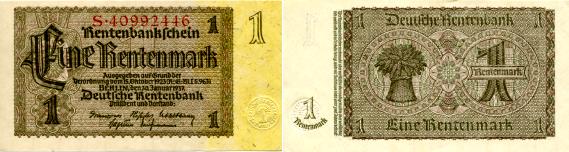

In
1937 Nazi Germany introduced a 1 Rentenmark note, in order to
replace the
nickel 1
Reichsmark coin. The coin was to be withdrawn so that the
nickel could be used in the upcoming war efforts. The
Rentenmark was equivalent to the Reichsmark,
however it was issued by
the Rentenbank rather than the Reichsbank and the currency was
theoretically backed by land rather than by gold. The note has the
embossed seal of the Rentenbank at the lower right hand corner.
A 1937 2 Rentenmark with a similar design was also issued and
was widely used after the minting of
silver
2 Reichmark was discontinued after the start of
World War II in 1939.
Item
PM-DE-1RNTMK-U NAZI GERMANY 1 RENTENMARK
NOTE 1937 P173AU-UNC OUT
Item
PM-DE-2RNTMK NAZI GERMANY 2 RENTENMARK NOTE
1937
P174 AU-UNC. $9.00
EMERGENCY WWII REICHSBANK
NOTE
This German 20 Reichsmark note was issued by the German Reichsbank in
Sudetenland and Lower Silesia at the very end of World War
II. Sudetenland and Lower Silesia were areas of
Czechoslovakia and Poland had been forcibly incorporated into Germany
at the start of World War II. Because of the advancing allied armies,
shipments of regular Germany currency were no longer available from
Berlin. The note is dated April 28, 1945, less than two weeks
before German surrendered. The tan and brown note is 150 ×
80mm.
PM-DE-SUDET
SUDETENLAND 20 REICHSMARK NOTE,
1945, P187 UNC. $25.00
WORLD WAR II
GERMAN
MILITARY CURRENCY
Wehrmacht military currency was used by Nazi Germany to pay its troops
during the final months of World War II. The notes are dated
September 15, 1944. Soldiers were paid in military scrip while in
transit. When a soldier arrived at his post the notes could be
converted to the local currency or occupation notes. The notes all have
similar designs. The front includes a small Eagle holding a Swastika
and the inscription "
VERRECHNUNGSSEN
FUR DIE DEUTSCHE WEHRMACHT"
(Clearing notes for German Armed Forces) The back of the note includes
regulations and instructions on how to use the notes. They are
interesting and historic pieces of World War II military history.
Item
PM-DE-MILIT1M GERMAN MILITARY 1
REICHSMARK NOTE 1944
PM38 UNC. $12.00
Item
PM-DE-MILIT5M GERMAN MILITARY 5
REICHSMARK NOTE 1944
PM39 UNC. $29.00
NAZI GERMAN OCCUPATION
CURRENCY
In order to control inflation and limit currency flows, a special
currency, called Reichskreditkassenschein was created for use in the
nations overrun by Hitler's forces. The notes were
denominated in German Reichsmark but could only be spent in an occupied
country, but not in Germany. German troops were paid in these notes,
thus effectively forcing the occupied nations to finance the cost of
their occupation. The undated notes were used from 1940 to
1945 and were used in German occupied Poland, Belgium, Denmark, Greece,
France, Guernsey, Jersey, Luxembourg, Norway, the USSR, and Yugoslavia.
The
5 Reichsmark
note depicts the head of farmer shouldering a scythe
and the head of a worker shouldering a hammer on the front.
The back depicts the Neue Wache building in Berlin.
Originally built in 1816 as a guard house for the Prussian royal
palace, since 1931 it has served as a war memorial and tomb of the
unknown soldier.
The
1 and 2 Reichsmark
include detailed underprinting, guilloches and the denomination on the
front and back. A
faint swastika underprint is on the center front of the 1 Reichsmark
Item
PM-DE-5M-OCC NAZI GERMAN OCCUPATION 5
REICHSMARK NOTE,
PR138 F-VF $5.00
Item
PM-DE-2M-OCC NAZI GERMAN OCCUPATION 2
REICHSMARK NOTE,
PR137 F-VF $4.00
Item
PM-DE-1M-OCC NAZI GERMAN OCCUPATION 1
REICHSMARK NOTE,
PR136 F-VF $4.00
NAZI
GERMANY CARVES UP CZECHOSLOVAKIA
In 1938 Nazi Germany occupied and carved up Czechoslovakia.
The western part became part of Germany. Other parts were
given to Poland and Hungary. What was left became two Nazi
puppet states: the Protectorate of Bohemia & Moravia and the
Slovak Republic.
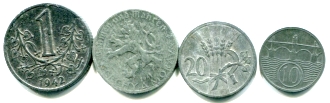
From
Bohemia & Moravia
we have the complete four coin set: 10, 20,
& 50 Haleru and 1 Koruna. The coins were struck in
zinc and featured the crowned Bohemian lion on the obverse.
The 1 Koruna was struck from 1941 to 1944 and had the denomination
within linden branches on the reverse. The lower
denominations were stuck from 1940 to 1944 and used the reverse designs
of the pre-war Czech coins: the St. Charles Bridge in Prague on the 10
Haleru, wheat ears and a sickle on the 20 Haleru, wheat ears and
linden branches on the 50 Haleru. Linden branches were
a traditional Bohemian symbols of love, stability, and
protection
Item
BOH-SET4 BOHEMIA & MORAVIA 4 COIN SET
1940-44 KM1-4 F-XF-minor spots $12.00
Item
BOH-SET4x5 5 of the abobe BOHEMIA &
MORAVIA 4 COIN SET
1940-44 $55.00
From the Nazi puppet state
of
Slovakia
we have the copper-nickel 1 and
5 Koruna. Both coins have the Slovak arms on
the obverse.
The 1 Koruna was minted from 1940 until 1945 and has the denomination
and wheat ears on the reverse. The 5 Koruna depicts Andrej
Hlinka. Hlinka was a Catholic priest, journalist, banker, leader of the
Slovak People’s Party, papal chamberlain and a member of the Czech
National Assembly. Above his portrait is the legend that translates
“Life for God. Freedom for Nation.” which is a bit ironic for an
occupied nation. It was the first coin issued by the Slovak Republic
and was minted only a single year: 1939, the year after Hlinka
died. In 1947 approximately 40% of the original mintage of
the 5 Korun was melted by the Czechoslovak National Bank.
Item
SK-1KR SLOVAKIA 1 KORUN 1940-45 KM6 VF-XF $4.00
Item
SK-5KR SLOVAKIA 5 KORUN 1939 KM2 VF-XF OUT
Also see:
 SLOVAK COIN FEATURES MEDIEVAL CRUCIFIX
NAZI OCCUPIED
BELGIUM COIN SET

Despite
being neutral, the Netherlands was attacked by Nazi Germany in May
1940. Belgian King Leopold III surrendered his nation 18 days
later without consulting his government. In return he was
allowed to keep his throne, though the government was controlled by
Nazi Germany. The kept the designs of the 10 and 25 Centimes
the same, but the coins were struck in zinc rather than
copper-nickel. They feature the monogram of King Leopold III
around a center hole on one side and the arms of Brussels (left), Mons
(middle) and Bruges (right) on the other. The name of the
country is in both French and Dutch. The zinc 1 Franc
features the national arms on the obverse and the King's monogram on
the other. The zinc 5 Francs depicts the king on one side and
the denomination on the other. The zinc coins continued to be
struck with the same designs until 1947. Because of his
collaboration with the Nazis the King was not allowed back in his
country following the war and formally abdicated in 1951.
Item
BE-WW2-SET4 BELGIUM WWII 10 & 25
CENTIMES, 1
& 5 FRANCS 1941-46 F-VF
$5.00
 NAZI
OCCUPIED NETHERLANDS
NAZI
OCCUPIED NETHERLANDS
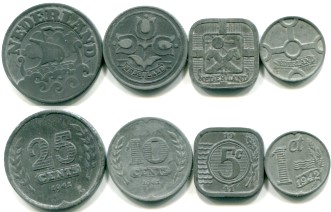
Despite
being neutral, the Netherlands was attacked and occupied by Nazi
Germany in May 1940. The Dutch government went into exile in London and
the Germans took over. New coins, made of zinc, were issued by
the German occupation government. The 1 Cent features a circled
cross on one side and a sprig of wheat on the other. The square 5
Cents the sun shining above a pair of crossed Saxon horse heads.
The 10 Cents depicts three tulips. The 25 Cents depicts a Viking
ship. The coins are dated 1941 to 1944.
Item
NL-WW2-SET4 NAZI OCCUPIED NETHERLANDS WWII 4
COIN SET F-VF
$12.00
DANISH WORLD WAR II ERA
ENCASED POSTAGE STAMP MONEY

These
encased postage stamps were issued in Denmark to help ease a coin
shortage
caused by World War II. A regular postage stamp was attached
to a
small cardboard holder and wrapped in cellophane or a similar
product.
Advertising was printed on the back of the holder to defray the cost of
the packaging. We have the 1 Ore encased postage stamps, with a wide
range
of advertising on the back. These are an unusual and rarely
seen
World War II monetary item. Because these come with many different
reverses,
the one you get may not be just like the one in the picture.
Item
DEN-STMP
DENMARK WWII ERA ENCASED POSTAGE STAMP $5.00
Item
DEN-STMPx3
3 DIFFERENT DENMARK WWII ERA ENCASED POSTAGE
STAMPS $12.00
Item
DEN-STMPx10
10 DIFFERENT DENMARK WWII ERA ENCASED POSTAGE
STAMPS $39.50
FIRST BANKNOTES NAZI GERMAN
OCCUPIED CROATIA & SERBIA
On April 6, 1941 Axis Forces under Nazi Germany invaded
Yugoslavia. They promptly conquered and divided the nation
along ethnic lines, creating the puppet governments for Croatia and
Serbia. Other parts of Yugoslavia were divided
between Italy, Bulgaria, Germany, Hungary and their client
regimes. Croatia was nominally ruled by an Italian
prince who never set foot in the country. Serbia directly
controlled by the German military. Yugoslavia was
reunited after World War II under communist rule. Ironically,
after the collapse of communism in 1991, it again broke-up along ethnic
lines.
From Croatia we have the first
notes issued by the Nazi puppet state, the 100 and 500 Kuna dated May
26, 1941, just seven weeks after the invasion. The 100 Kuna
features the Croatian coat of arms and is 150 x 80mm. The 500
Kuna three sheaves of wheat and is 160 x 84mm. The notes were
printed in Germany Giesecke & Devrient, a private company which
is still a major banknote printer.
From Serbia we have the
overprinted 100 Dinara note dated May 1, 1941. After invading
Yugoslavia, the Germans found a large quantity of the beautiful 1929
Yugoslavian 100 Dinara banknotes in the vaults of the Central
Bank. The front of the notes picture a seated woman holding a
sword overlooking a village on a bay. The back pictured
sailboats and a young man with fruit leaning on the arms of
Yugoslavia. The Germans put an ugly brown overprint on what
was one of the world's prettiest banknotes in an attempt to cover up
all references to Yugoslavia. The note measures 172 x 101mm.
Item
PM-HR-100K NAZI CROATIA 100 KUNA NOTE 1941
P2 F-VF
$10.00
Item
PM-HR-500K NAZI CROATIA 500 KUNA NOTE 1941
P3 F-VF
$10.00
Item
PM-RS-OVPT-100D NAZI SERBIA 100 DINARA 1941
OVERPRINTED NOTE P23 AU-UNC.
$13.00
COINS OF
NAZI OCCUPIED
SERBIA

On
April 6, 1941 Nazi German forces invaded Yugoslavia. The country was
quickly conquered and divided along ethnic lines. Serbia was directly
controlled by the German military. This three coin set
includes the
1942 1 and 2 Dinars and the 1943 Dinars. The coins were
struck only a
single year. All three coins have similar designs with the denomination
and date on one side and the Serbian arms without the royal crown on
the other.
Item
RS-NAZI3 NAZI OCCUPIED SERBIA 3 COIN SET 1 -
10 DINARS 1942-43 KM31-33 F-XF $16.00
Item
RS-NAZI-2D NAZI OCCUPIED SERBIA 2 DINAR FROM
ABOVE SET KM32 VF-XF
$5.00
FASCIST
ITALY SILVER COIN OF VICTOR EMMANUEL III

This
silver 5 Lire of Fascist Italy dates from 1927 to 1930. King
Victor Emmanuel III (Vittorio Emanuele III) is on the
obverse. An eagle and fasces, the emblem of Fascist Italy is
on the reverse. By 1927 Mussolini had turned Italy into a
dictatorship and the king was largely a figurehead. The 23mm coin
weighs 5 grams and contains .1342 troy ounces of silver. It
is an historic silver coin of Fascist Italy.
Item
IT-VE3-5L ITALY SILVER 5 LIRE, 1927-30 KM67
VF-XF
$18.00
WWII FASCIST
ITALY COIN SETS 
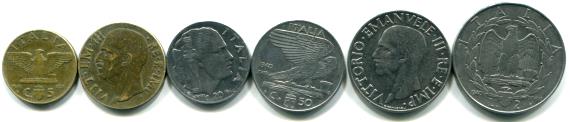
These
coins of Fascist Italy depict King Victor Emmanuele as a Roman Emperor
on the obverse. The reverses all include a fasces in the
design, in an attempt to show that Mussolini and the Fascists were the
power behind the throne. The coins date from 1936 until 1943, when the
king deposed Mussolini and joined with the Allies. The
four-coin set includes the 5, 10, 20 and 50 Centesimi. The
six coin set includes those four coins, plus the 1 and 2 Lire.
Item
IT-SET-FASCIST4 ITALY 4 COIN SET 5-50
CENTESIMI 1936-43 VF-AU
$7.00
Item
IT-SET-FASCIST6 ITALY 6 COIN SET 5
CENTESIMI- 2 LIRE 1936-43 VF-AU
$15.00
WORLD
WAR II COIN OF SPAIN

Though
Francisco Franco and the Spanish Nationalists received heavy
assistance
from Hitler during the Spanish Civil War and the two were ideologically
similar, Spain never officially joined the Axis powers in World War
II. Spain provided volunteers to fight against Russia, but
insisted they not be used on the western front. Negotiations between
Hitler and Franco concerning Spain formally entering the war did not go
well, with Hitler reportedly saying "
I prefer to have three or four
of
my own teeth pulled out than to speak to that man
again!". This 1944 21mm
aluminum-bronze Spanish 1
Peseta depicts coat of arms of Spain on the obverse. The
reverse features the historical symbols of Spain around the
denomination: a pomegranate for Granada, four pallets for
Aragon, a castle of Castile, a lion for Leon, chains for Navarre and a
bundle of arrows for the Catholic Monarchs (Ferdinand and Isabella) who
united the country.
Item
ES-1P SPAIN 1 PESETA 1944 KM767 F-VF
$3.00
FIRST POST-WORLD
WAR II COIN OF
LUXEMBOURG

Before
World War II Luxembourg was a neutral nation. In 1939 Adolf
Hitler promised to respect Luxembourg's sovereignty, however on May 9,
1940 Germany invaded. The Luxembourg army of 425 soldiers and
13 officers were no match against the powerful German Wehrmacht and
the country fell within hours. A forceful campaign of Germanization was
begun and in 1942 Luxembourg was officially made part of
Germany. This 1946 1 Franc was one of the first coins issued
by Luxembourg after Germany's defeat in 1945. The design of
the 23mm copper-nickel coin is similar to that of the pre-war 1
Franc. The obverse features a bare-chested steelworker poking
at flames (occupational safety regulations were much looser then), in
the background smoke rises from smokestacks (pollution laws were also
much looser). The reverse features the crowned monogram of
Grand Duchess Charlotte.
Item
LU-1F LUXEMBOURG 1 FRANC 1946 KM46.1 BU $3.00
WORLD WAR II
JAPANESE 1 SEN COINS
The 1 Sen coin was the lowest denomination in circulation in Japan by
the beginning of World War I. It was worth 1/100 of a Yen.
Japan’s decline in World War II is reflected in the decline of its 1
Sen coin. During 1938 Japan replaced the
bronze
1 Sen coin with a 17.6 aluminum coin bearing the
same design (Y56) . In 1941 the 1 Sen was reduced to a 16mm aluminum
coin (Y59). Mount Fuji and the Chrysanthemum seal
are on
one side and the denomination on the other. In 1944 the 1 Sen was
further reduced to a 15mm zinc coin (Y62). The Chrysanthemum seal is on
one
side and the name of the country “Great Japan” and the date is on the
other. The coin was discontinued after Japan’s defeat in
World War II, having lost virtually all of its value.
Item
JP-SET3 JAPAN SET OF THREE 1 SEN COINS
1938-1948 VF-AU $4.00
WORLD WAR II JAPANESE
MILITARY CURRENCY FOR HONG KONG
Japan issued this 100 Yen note for use in Hong Kong in the closing
months of World War II. It was the highest denomination military
currency issued by Japan. The note, apparently printed in Hong Kong,
utilized the basic design of the 1944 Japanese homeland 100 Yen note,
however with modified legends on the back and the front has an
overprint that translates as "Military Currency". The note pictures the
Yumedono Pavilion, or Hall of Dreams. It was constructed in
739 as a monument to the semi-legendary Prince Shotoku Taishi on the
site of the prince's palace. The prince is pictured to the
right within a green circle. Because civilians were forced to accept
were forced to accept the unbacked Military Yen it cost the Japanese
government virtually nothing to purchase whatever they
wanted. The note large sized note is 163 x 94mm and is
Uncirculated.
Item
PM-CN-M100Y JAPANESE MILITARY CURRENCY FOR
HONG KONG 100 YEN 1945 PM30 AU-UNC.
$12.00
Item
PM-CN-M100Yx5 5 of the above JAPANESE
MILITARY 100 YEN NOTES 1945 PM30 AU-UNC.
$45.00
JAPANESE
INVASION MONEY
As Japanese forces conquered Burma, Malaya and the
Philippines in World War II they introduced their own
currency. Anyone found with any other type of currency was
subject to severe punishment. As English was the official
language of these three colonies, the notes were printed in English and
were denominated in the currency that had been in
circulation. The notes were only labeled “THE JAPANESE
GOVERNMENT” without mentioning the colony. The red 10 Rupee
note for Burma depict the Ananda Temple in Bagan. The dark
blue and yellow 10 Dollar note for Malaya includes bananas, breadfruit
and
coconuts on the front and a ship steaming in the horizon on the
back. The black and light blue Philippine 10 Pesos
note depicts a banana plantation.
Item
PM-JIM3 JAPANESE INVASION MONEY: BURMA 10
RUPEE, MALAYA $10 &
PHILIPPINES 10 PESOS VF-AU
$4.00
Item
PM-JIM3x10 10 SETS OF THE ABOVE THREE
JAPANESE INVASION MONEY VF-AU
$22.50
JAPANESE
INVASION OF
THE UNITED STATES?

When these 10 Dollar notes issued by The Japanese Government started
showing up shortly after World War II, many people took it as proof
that Japan planned to invade the United States, and had their new
currency for the United States already printed. The story was
repeated so many times that many believed it must be true.
Though the Japanese government did print the notes, they were for use
in Malaya, which Japan conquered by early 1942, not the United
States. Like the United States, Malaya called their
currency the Dollar. However, the design is much more suited
to Malaya than the United States. The front features bananas,
breadfruit and coconuts. The back pictures palm trees and a ship
steaming on the horizon. Each note has two sets of block letters,
starting with the letter “M”, which stood for Malaya. As an
anti-counterfeiting measure tiny colored silk threads were embedded
into the paper. These unissued, Crisp Uncirculated 10 Dollar
notes were abandoned by the Japanese forces in Malaya after Japan’s
surrender in 1945. They sat in storage for many years since
then. Today they are historic collector’s items
recalling Japan’s unsuccessful attempt to extend her empire across Asia
in World War II.
Item
PM-MY-JIM$10 JAPANESE INVASION OF
MALAYA 10 DOLLARS PM7c UNC. $3.00
Item
PM-MY-JIM$10x10 10 of the above JAPANESE
INVASION OF MALAYA 10 DOLLARS PM7c UNC
$15.00
WORLD
WAR II COINS FROM BRITISH INDIA
India was critical to the Allied effort in World War II. It
contributed over 2.5 million troops and was a major producer of
armaments and equipment. Two versions of the World War II
era bronze 1/4 Anna were produced. Both depict King
George VI on the obverse and denomination and date on the reverse.
In the first versoin which was struck in 1938 and 1939 the
tips of the fleur-de-lis in the King's crown touched the jeweled band
of the crown. In the second version which was struck from
1940 until 1942, the fleur-de-lis were shorter. The king's
head flatter but with more distinct
features in the second version. By 1942
the bronze 1/4 Anna had minimal buying power and it utilized copper
that was needed for the war effort. Production was
discontinued that year. The same year a much smaller, 17.3mm square
nickel-brass 1/2 Anna was introduced. It might buy a cup of
tea or a small snack. The 1/2 Anna has the denomination
written in English, Urdu, Bengali, Telugu & Devanagari on the
reverse. Both coins portray Emperor George VI on
the obverse.
Item
IN-QTR-39 INDIA 1/4 ANNA 1939 1st VERSION
KM530 AU-UNC $6.00
Item
IN-QTR-40 INDIA 1/4 ANNA 1940 2nd VERSION
KM531 AU-UNC $5.00
Item
IN-QTR-41 INDIA 1/4 ANNA 1941 2nd VERSION
KM531 AU-UNC $5.00
Item
IN-QTR-42 INDIA 1/4 ANNA 1942 2nd VERSION
KM531 AU-UNC $5.00
Item
IN-QTR-x10 10 of the above INDIA 1/4 ANNA
1939-42, MIXED DATES AU-UNC $29.75
Item
IN-HALF-42 INDIA 1/2 ANNA 1942 KM534b UNC $5.00
Item
IN-HALF-43 INDIA 1/2 ANNA 1943 KM534b UNC $5.00
Item
IN-HALF-44 INDIA 1/2 ANNA 1944 KM534b UNC $6.00
Item
IN-HALFx10 10 of the above INDIA 1/2 ANNA
1942-43 mixed dats KM534b UNC $29.75
UNITED STATES WORLD WAR
II RATION
TOKENS AND CHECKS
During World War II the United States implemented a complicated system
of rationing and price controls on many food and non-food items which
was operated by the Office of Price Administration (OPA). The
system included ration books, stamps, coupons, tokens and checks.
Families would be issued ration books containing ration stamps or
coupons which would be good for only a limited period of
time. In order to purchase a rationed item, the buyer needed
to provide both the correct payment and the appropriate number of
ration points. Each ration stamp was worth 10 ration points,
but many items required fewer points. Initially merchants
were unable to make ration point change, resulting in consumers being
forced to waste valuable ration points. In 1944 red and blue ration
tokens were introduced in order to make change for food items and allow
for small purchases. Each token was good for 1 ration
point. Red tokens could be used for meats or fats.
Blue tokens were for processed foods. The tokens are all vulcanized
fiber and 16mm in diameter. They have the same design on both
sides with the legend "OPA RED POINT" or "OPA BLUE POINT", and the
numeral
"1". Each token also has two small letters next to thel "1",
though it is not clear what is the reason for the letters.
Ration checks were used for commercial transactions involving merchants
or commercial entities. The checks are like regular business
checks and were processed through banks and the Federal Reserve system
like checks, but were made out for points or foods rather and
dollars. We have cancelled OPA Ration Checks for Pounds of
Sugar and for Processed Foods points drawn on the Exchange Bank of
Bloomfield Iowa dated 1943.
Item
OPA-TKN-SET2 UNITED STATES RED AND BLUE OPA
RATION TOKENS (1944-45) VF-XF
$3.00
Item
OPA-CHK-FOOD-GR UNITED STATES WORLD WAR II
PROCESSED FOODS RATION CHECK, GREEN, 1943 $4.00
Item
OPA-CHK-FOOD-YL UNITED STATES WORLD WAR II
PROCESSED FOODS RATION CHECK, YELLOW 1943 $5.00
Item
OPA-CHK-SUGAR UNITED STATES WORLD WAR
II SUGAR RATION CHECK 1943 $4.00
WORLD
WAR II
CANADIAN MEAT
RATION TOKEN
 Meat
was rationed in Canada during World War II. Families received
a ration booklet which allowed them to purchase a limited quantity of
rationed goods, including tea, coffee, sugar, butter, booze and meat
each week. Each weekly meat ration coupon was good for 2
pounds of meat. The problem was that many did not have
refrigeration at home, so they would either forfeit the whole coupon
for a lesser amount of meat, or buy their full amount and risk it going
bad before it could be used. In 1945 the Canadian government
finally wised up and issued meat ration tokens that were good for a
lesser quantity of meat. Each token was worth 1/8 of a meat ration
coupon (1/4 pound of meat), so if someone bought less than their full
ration of meat the tokens could be given out to be used
later. If one bought half their weekly ration of meat, they
would receive four tokens for later use. The 22mm blue token
is struck on a heavy blue cardboard with a center hole. Both sides have
the same design with the words "CANADA
- RATION MEAT - VIANDE" and two
maple leaves.
Meat
was rationed in Canada during World War II. Families received
a ration booklet which allowed them to purchase a limited quantity of
rationed goods, including tea, coffee, sugar, butter, booze and meat
each week. Each weekly meat ration coupon was good for 2
pounds of meat. The problem was that many did not have
refrigeration at home, so they would either forfeit the whole coupon
for a lesser amount of meat, or buy their full amount and risk it going
bad before it could be used. In 1945 the Canadian government
finally wised up and issued meat ration tokens that were good for a
lesser quantity of meat. Each token was worth 1/8 of a meat ration
coupon (1/4 pound of meat), so if someone bought less than their full
ration of meat the tokens could be given out to be used
later. If one bought half their weekly ration of meat, they
would receive four tokens for later use. The 22mm blue token
is struck on a heavy blue cardboard with a center hole. Both sides have
the same design with the words "CANADA
- RATION MEAT - VIANDE" and two
maple leaves.
Item
CA-MEAT
CANADA WWII MEAT RATION TOKEN, UNC.
$3.00
WWII CANADA V "NICKEL"
INCLUDES HIDDEN MORSE CODE MESSAGE
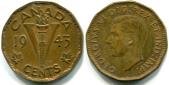
On
January 1, 1943 Canada released a new design for their 5-cent coin to
promote the war effort of World War II. The reverse featured a large
"V" behind a burning torch. The V both stood for Victory and
the
denomination in Roman numerals. Around the rim is the inscription in
Morse code which reads "WE WIN WHEN WE WORK WILLINGLY". The coins
distinctive both because it is 12-sided and is struck in a brass alloy
called tombac, in order to save nickel for the war effort.
King George
V is on the obverse. Even though the coin is not made of
nickel, it is
often referred to as Canada's V Nickel.
Item
CA-5C-43 CANADA 5 CENTS 1943 KM40 VICTORY,
VF-XF $3.00
CANADA 2020 WORLD
WAR II VICTORY
2 DOLLAR COIN

Canada
commemorated the 75th anniversary of the end of World War II
with this multi-color 2020 2 Dollar coin.
The coins have similar reverse designs which were adapted from
Canada's World War II era Victory 5 cent
coins. The designs feature a torch and a large "V"
in the center. On the outer ring is the inscription
"WE WIN WHEN WE
WORK WILLINGLY" in Morse code and the words Victory and
Remember are in
English and French. At the top are two shifting images of a
maple leaf within the line pattern. The obverse depicts the
portrait of Queen Elizabeth II.
Item
CA-2D-COL-VICT CANADA COLOR 2 DOLLARS 2020
WWII UNC.
$7.00
UNCIRCULATED
WORLD WAR II COINS OF MEXICO

World War II was a time of prosperity
for Mexico. Its minerals were much in demand for the war
effort. Many Mexicans went to the north to work in
agriculture to cover for the shortage farm labor in the United
States. These Uncirculated 5 Centavos bronze 5 Centavos are
dated 1944 and 1945, during the height of Mexico’s
prosperity. The 25.5mm bronze coins depict Josefa Ortiz De
Dominguez, one of the hero’s of Mexico’s War of Independence. Behind
her head is the Mexico City mintmark. The other side
features Mexico’s national emblem of an eagle on a cactus eating
a snake. It is an attractive coin that is quite reasonably
priced considering it is over 80 years old and still in it’s original
mint condition.
Item
MX-5C-44 MEXICO 5 CENTAVOS 1944 KM424 UNC. $2.00
Item
MX-5C-45 MEXICO 5 CENTAVOS 1945 KM424 UNC. $2.00
Item
MX-5C-BTH BOTH OF THE ABOVE MEXICAN 5
CENTAVOS,
1944 & 1945 UNC.$3.00
GENERAL MacARTHUR
MEMORIAL
MEDAL

This
attractive 38.9 mm medal commemorating General Douglas MacArthur was
struck shortly after his death in 1964 by Capitol Medals. The obverse
pictures the General. The reverse has two of his most famous quotes: "
I shall Return" and
"
Old soldiers never die;
they just fade away". The oxidized
silver-plated bronze medal comes in an envelope with a descriptive
brochure.
Item
MacARTHUR GENERAL MacARTHUR SILVER-PLATED
MEDAL $9.75
ALLIED
LEADERS OF
WORLD WAR II
Winston Churchill served
as Prime Minister of Great Britain during the
World War II years of 1940 to 1945. His speeches and radio broadcasts
helped inspire British confidence, especially during the difficult
early years of the war when Britain stood almost alone against Nazi
Germany. He was honored after his death in 1965 on the
British 5 Shillings coin (1 Crown). It was the first British
coin to portray a commoner since the 1650’s and it was the last 5
Shilling coin ever struck by Great Britain. The obverse of the 38.6mm
copper-nickel coin has Mary Gillick’s portrait of young Queen
Elizabeth. The reverse portrays a rough portrait of
Churchill.
Dwight David Eisenhower
was a five-star general in the United States
Army during World War II and served as Supreme Allied Commander in
Europe. He led the invasion of North Africa in 1942–43 and the
successful invasion of France and Germany in 1944–45. He
served as the 34th President of the United States from 1953 to
1961. He is portrayed on the 2015 United States Presidential “Golden
Dollar”. The 2015 Eisenhower Presidential dollar features the
Statue of Liberty on
the reverse. The date, mintmark and legends are on the edge
of the coin. The coin was not
released into circulation but was only available from the mint as part
of a set or in rolls or bags at a
premium. Despite the coins coming directly from the original
mint bags,
most
coins have nicks or bagmarks.
Item
GB-CHURCH GREAT BRITAIN 1 CROWN 1965 WINSTON
CHURCHILL KM910 AU-UNC. $3.50
Item
US-SMALLIKE UNITED STATES 1 DOLLAR 2015-P
PRESIDENT EISENHOWER
UNC-nicks $3.00
CHINA CELEBRATES WORLD WAR II
VICTORY
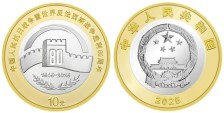
China
issued this circulating commemorative 2025 bi-metallic 10 Yuan coin to
commemorate the "80th Anniversary of the Victory in the Chinese
People’s War of Resistance Against Japanese Aggression and the World
Anti-Fascist War" or what is commonly called World War II.
The coin depicts a portion of the Great Wal of China with the numeral
"80" on a guard tower. Below are the dates 1945-2025. The
emblem of the People's Republic of China is on the obverse.
Item
CN-10Y25-WWII CHINA 10 YUAN 2025 80th
ANNIVERSARY OF WORLD WAR II VICTORY, BU
$7.00
 FRANCE
HONORS CHARLES DE GAULLE
FRANCE
HONORS CHARLES DE GAULLE
France
honored Charles de Gaulle on their 2020 2 Euro coin. The coin
commemorates both the 50th anniversary of his death in 1970 and the
80th anniversary of his Appeal of 18 June, which was an appeal launched
by de Gaulle on June 18, 1940 from the BBC studios in London that
established the French Resistance against Nazi Germany. The
coin depicts images of him both as President of France in the 1960's
and as a General in World War II.
Item
FR-2E20-DEGAULLE FRANCE 2 EUROS 2020 CHARLES
DE GAULLE UNC. $7.00
LOW
MINTAGE COLOR BATTLE OF
BRITAIN COMMEMORATIVE
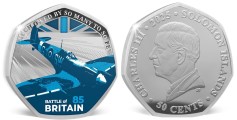 Solomon
Islands issued this 2025 multi-color Proof-like 50 Cents to commemorate
the 85th Anniversary of the Battle of Britain. The 28.5mm,
seven-sided, silver-plated coin depicts a multi-color Spitfire and
bears the legend "SO
MUCH OWED BY SO MANY TO SO FEW". King
Charles III is on the obverse. The coin has a mintage of only
499 pieces and comes in a presentation card.
Solomon
Islands issued this 2025 multi-color Proof-like 50 Cents to commemorate
the 85th Anniversary of the Battle of Britain. The 28.5mm,
seven-sided, silver-plated coin depicts a multi-color Spitfire and
bears the legend "SO
MUCH OWED BY SO MANY TO SO FEW". King
Charles III is on the obverse. The coin has a mintage of only
499 pieces and comes in a presentation card.
Item
SB-BATTLE SOLOMON ISLANDS 50 CENTS 2025 BATTLE
OF BRITAIN, PROOFLIKE
$19.95
ALSO SEE:
GERMAN COINS & CURRENCY PAGE
NAZI
COINS PAGE
JAPANESE COINS &
CURRENCY PAGE
RUSSIA
WWII CITIES OF MILITARY GLORY COINS
<--
PREVIOUS PAGE NEXT
PAGE -->


 From
Bohemia & Moravia
we have the complete four coin set: 10, 20,
& 50 Haleru and 1 Koruna. The coins were struck in
zinc and featured the crowned Bohemian lion on the obverse.
The 1 Koruna was struck from 1941 to 1944 and had the denomination
within linden branches on the reverse. The lower
denominations were stuck from 1940 to 1944 and used the reverse designs
of the pre-war Czech coins: the St. Charles Bridge in Prague on the 10
Haleru, wheat ears and a sickle on the 20 Haleru, wheat ears and
linden branches on the 50 Haleru. Linden branches were
a traditional Bohemian symbols of love, stability, and
protection
From
Bohemia & Moravia
we have the complete four coin set: 10, 20,
& 50 Haleru and 1 Koruna. The coins were struck in
zinc and featured the crowned Bohemian lion on the obverse.
The 1 Koruna was struck from 1941 to 1944 and had the denomination
within linden branches on the reverse. The lower
denominations were stuck from 1940 to 1944 and used the reverse designs
of the pre-war Czech coins: the St. Charles Bridge in Prague on the 10
Haleru, wheat ears and a sickle on the 20 Haleru, wheat ears and
linden branches on the 50 Haleru. Linden branches were
a traditional Bohemian symbols of love, stability, and
protection

 Despite
being neutral, the Netherlands was attacked by Nazi Germany in May
1940. Belgian King Leopold III surrendered his nation 18 days
later without consulting his government. In return he was
allowed to keep his throne, though the government was controlled by
Nazi Germany. The kept the designs of the 10 and 25 Centimes
the same, but the coins were struck in zinc rather than
copper-nickel. They feature the monogram of King Leopold III
around a center hole on one side and the arms of Brussels (left), Mons
(middle) and Bruges (right) on the other. The name of the
country is in both French and Dutch. The zinc 1 Franc
features the national arms on the obverse and the King's monogram on
the other. The zinc 5 Francs depicts the king on one side and
the denomination on the other. The zinc coins continued to be
struck with the same designs until 1947. Because of his
collaboration with the Nazis the King was not allowed back in his
country following the war and formally abdicated in 1951.
Despite
being neutral, the Netherlands was attacked by Nazi Germany in May
1940. Belgian King Leopold III surrendered his nation 18 days
later without consulting his government. In return he was
allowed to keep his throne, though the government was controlled by
Nazi Germany. The kept the designs of the 10 and 25 Centimes
the same, but the coins were struck in zinc rather than
copper-nickel. They feature the monogram of King Leopold III
around a center hole on one side and the arms of Brussels (left), Mons
(middle) and Bruges (right) on the other. The name of the
country is in both French and Dutch. The zinc 1 Franc
features the national arms on the obverse and the King's monogram on
the other. The zinc 5 Francs depicts the king on one side and
the denomination on the other. The zinc coins continued to be
struck with the same designs until 1947. Because of his
collaboration with the Nazis the King was not allowed back in his
country following the war and formally abdicated in 1951. Despite
being neutral, the Netherlands was attacked and occupied by Nazi
Germany in May 1940. The Dutch government went into exile in London and
the Germans took over. New coins, made of zinc, were issued by
the German occupation government. The 1 Cent features a circled
cross on one side and a sprig of wheat on the other. The square 5
Cents the sun shining above a pair of crossed Saxon horse heads.
The 10 Cents depicts three tulips. The 25 Cents depicts a Viking
ship. The coins are dated 1941 to 1944.
Despite
being neutral, the Netherlands was attacked and occupied by Nazi
Germany in May 1940. The Dutch government went into exile in London and
the Germans took over. New coins, made of zinc, were issued by
the German occupation government. The 1 Cent features a circled
cross on one side and a sprig of wheat on the other. The square 5
Cents the sun shining above a pair of crossed Saxon horse heads.
The 10 Cents depicts three tulips. The 25 Cents depicts a Viking
ship. The coins are dated 1941 to 1944. These
encased postage stamps were issued in Denmark to help ease a coin
shortage
caused by World War II. A regular postage stamp was attached
to a
small cardboard holder and wrapped in cellophane or a similar
product.
Advertising was printed on the back of the holder to defray the cost of
the packaging. We have the 1 Ore encased postage stamps, with a wide
range
of advertising on the back. These are an unusual and rarely
seen
World War II monetary item. Because these come with many different
reverses,
the one you get may not be just like the one in the picture.
These
encased postage stamps were issued in Denmark to help ease a coin
shortage
caused by World War II. A regular postage stamp was attached
to a
small cardboard holder and wrapped in cellophane or a similar
product.
Advertising was printed on the back of the holder to defray the cost of
the packaging. We have the 1 Ore encased postage stamps, with a wide
range
of advertising on the back. These are an unusual and rarely
seen
World War II monetary item. Because these come with many different
reverses,
the one you get may not be just like the one in the picture.


 On
April 6, 1941 Nazi German forces invaded Yugoslavia. The country was
quickly conquered and divided along ethnic lines. Serbia was directly
controlled by the German military. This three coin set
includes the
1942 1 and 2 Dinars and the 1943 Dinars. The coins were
struck only a
single year. All three coins have similar designs with the denomination
and date on one side and the Serbian arms without the royal crown on
the other.
On
April 6, 1941 Nazi German forces invaded Yugoslavia. The country was
quickly conquered and divided along ethnic lines. Serbia was directly
controlled by the German military. This three coin set
includes the
1942 1 and 2 Dinars and the 1943 Dinars. The coins were
struck only a
single year. All three coins have similar designs with the denomination
and date on one side and the Serbian arms without the royal crown on
the other.  This
silver 5 Lire of Fascist Italy dates from 1927 to 1930. King
Victor Emmanuel III (Vittorio Emanuele III) is on the
obverse. An eagle and fasces, the emblem of Fascist Italy is
on the reverse. By 1927 Mussolini had turned Italy into a
dictatorship and the king was largely a figurehead. The 23mm coin
weighs 5 grams and contains .1342 troy ounces of silver. It
is an historic silver coin of Fascist Italy.
This
silver 5 Lire of Fascist Italy dates from 1927 to 1930. King
Victor Emmanuel III (Vittorio Emanuele III) is on the
obverse. An eagle and fasces, the emblem of Fascist Italy is
on the reverse. By 1927 Mussolini had turned Italy into a
dictatorship and the king was largely a figurehead. The 23mm coin
weighs 5 grams and contains .1342 troy ounces of silver. It
is an historic silver coin of Fascist Italy. These
coins of Fascist Italy depict King Victor Emmanuele as a Roman Emperor
on the obverse. The reverses all include a fasces in the
design, in an attempt to show that Mussolini and the Fascists were the
power behind the throne. The coins date from 1936 until 1943, when the
king deposed Mussolini and joined with the Allies. The
four-coin set includes the 5, 10, 20 and 50 Centesimi. The
six coin set includes those four coins, plus the 1 and 2 Lire.
These
coins of Fascist Italy depict King Victor Emmanuele as a Roman Emperor
on the obverse. The reverses all include a fasces in the
design, in an attempt to show that Mussolini and the Fascists were the
power behind the throne. The coins date from 1936 until 1943, when the
king deposed Mussolini and joined with the Allies. The
four-coin set includes the 5, 10, 20 and 50 Centesimi. The
six coin set includes those four coins, plus the 1 and 2 Lire. Though
Francisco Franco and the Spanish Nationalists received heavy
assistance
from Hitler during the Spanish Civil War and the two were ideologically
similar, Spain never officially joined the Axis powers in World War
II. Spain provided volunteers to fight against Russia, but
insisted they not be used on the western front. Negotiations between
Hitler and Franco concerning Spain formally entering the war did not go
well, with Hitler reportedly saying "I prefer to have three or four
of
my own teeth pulled out than to speak to that man
again!". This 1944 21mm
aluminum-bronze Spanish 1
Peseta depicts coat of arms of Spain on the obverse. The
reverse features the historical symbols of Spain around the
denomination: a pomegranate for Granada, four pallets for
Aragon, a castle of Castile, a lion for Leon, chains for Navarre and a
bundle of arrows for the Catholic Monarchs (Ferdinand and Isabella) who
united the country.
Though
Francisco Franco and the Spanish Nationalists received heavy
assistance
from Hitler during the Spanish Civil War and the two were ideologically
similar, Spain never officially joined the Axis powers in World War
II. Spain provided volunteers to fight against Russia, but
insisted they not be used on the western front. Negotiations between
Hitler and Franco concerning Spain formally entering the war did not go
well, with Hitler reportedly saying "I prefer to have three or four
of
my own teeth pulled out than to speak to that man
again!". This 1944 21mm
aluminum-bronze Spanish 1
Peseta depicts coat of arms of Spain on the obverse. The
reverse features the historical symbols of Spain around the
denomination: a pomegranate for Granada, four pallets for
Aragon, a castle of Castile, a lion for Leon, chains for Navarre and a
bundle of arrows for the Catholic Monarchs (Ferdinand and Isabella) who
united the country.  Before
World War II Luxembourg was a neutral nation. In 1939 Adolf
Hitler promised to respect Luxembourg's sovereignty, however on May 9,
1940 Germany invaded. The Luxembourg army of 425 soldiers and
13 officers were no match against the powerful German Wehrmacht and
the country fell within hours. A forceful campaign of Germanization was
begun and in 1942 Luxembourg was officially made part of
Germany. This 1946 1 Franc was one of the first coins issued
by Luxembourg after Germany's defeat in 1945. The design of
the 23mm copper-nickel coin is similar to that of the pre-war 1
Franc. The obverse features a bare-chested steelworker poking
at flames (occupational safety regulations were much looser then), in
the background smoke rises from smokestacks (pollution laws were also
much looser). The reverse features the crowned monogram of
Grand Duchess Charlotte.
Before
World War II Luxembourg was a neutral nation. In 1939 Adolf
Hitler promised to respect Luxembourg's sovereignty, however on May 9,
1940 Germany invaded. The Luxembourg army of 425 soldiers and
13 officers were no match against the powerful German Wehrmacht and
the country fell within hours. A forceful campaign of Germanization was
begun and in 1942 Luxembourg was officially made part of
Germany. This 1946 1 Franc was one of the first coins issued
by Luxembourg after Germany's defeat in 1945. The design of
the 23mm copper-nickel coin is similar to that of the pre-war 1
Franc. The obverse features a bare-chested steelworker poking
at flames (occupational safety regulations were much looser then), in
the background smoke rises from smokestacks (pollution laws were also
much looser). The reverse features the crowned monogram of
Grand Duchess Charlotte.


 Meat
was rationed in Canada during World War II. Families received
a ration booklet which allowed them to purchase a limited quantity of
rationed goods, including tea, coffee, sugar, butter, booze and meat
each week. Each weekly meat ration coupon was good for 2
pounds of meat. The problem was that many did not have
refrigeration at home, so they would either forfeit the whole coupon
for a lesser amount of meat, or buy their full amount and risk it going
bad before it could be used. In 1945 the Canadian government
finally wised up and issued meat ration tokens that were good for a
lesser quantity of meat. Each token was worth 1/8 of a meat ration
coupon (1/4 pound of meat), so if someone bought less than their full
ration of meat the tokens could be given out to be used
later. If one bought half their weekly ration of meat, they
would receive four tokens for later use. The 22mm blue token
is struck on a heavy blue cardboard with a center hole. Both sides have
the same design with the words "CANADA
- RATION MEAT - VIANDE" and two
maple leaves.
Meat
was rationed in Canada during World War II. Families received
a ration booklet which allowed them to purchase a limited quantity of
rationed goods, including tea, coffee, sugar, butter, booze and meat
each week. Each weekly meat ration coupon was good for 2
pounds of meat. The problem was that many did not have
refrigeration at home, so they would either forfeit the whole coupon
for a lesser amount of meat, or buy their full amount and risk it going
bad before it could be used. In 1945 the Canadian government
finally wised up and issued meat ration tokens that were good for a
lesser quantity of meat. Each token was worth 1/8 of a meat ration
coupon (1/4 pound of meat), so if someone bought less than their full
ration of meat the tokens could be given out to be used
later. If one bought half their weekly ration of meat, they
would receive four tokens for later use. The 22mm blue token
is struck on a heavy blue cardboard with a center hole. Both sides have
the same design with the words "CANADA
- RATION MEAT - VIANDE" and two
maple leaves.  On
January 1, 1943 Canada released a new design for their 5-cent coin to
promote the war effort of World War II. The reverse featured a large
"V" behind a burning torch. The V both stood for Victory and
the
denomination in Roman numerals. Around the rim is the inscription in
Morse code which reads "WE WIN WHEN WE WORK WILLINGLY". The coins
distinctive both because it is 12-sided and is struck in a brass alloy
called tombac, in order to save nickel for the war effort.
King George
V is on the obverse. Even though the coin is not made of
nickel, it is
often referred to as Canada's V Nickel.
On
January 1, 1943 Canada released a new design for their 5-cent coin to
promote the war effort of World War II. The reverse featured a large
"V" behind a burning torch. The V both stood for Victory and
the
denomination in Roman numerals. Around the rim is the inscription in
Morse code which reads "WE WIN WHEN WE WORK WILLINGLY". The coins
distinctive both because it is 12-sided and is struck in a brass alloy
called tombac, in order to save nickel for the war effort.
King George
V is on the obverse. Even though the coin is not made of
nickel, it is
often referred to as Canada's V Nickel.
 World War II was a time of prosperity
for Mexico. Its minerals were much in demand for the war
effort. Many Mexicans went to the north to work in
agriculture to cover for the shortage farm labor in the United
States. These Uncirculated 5 Centavos bronze 5 Centavos are
dated 1944 and 1945, during the height of Mexico’s
prosperity. The 25.5mm bronze coins depict Josefa Ortiz De
Dominguez, one of the hero’s of Mexico’s War of Independence. Behind
her head is the Mexico City mintmark. The other side
features Mexico’s national emblem of an eagle on a cactus eating
a snake. It is an attractive coin that is quite reasonably
priced considering it is over 80 years old and still in it’s original
mint condition.
World War II was a time of prosperity
for Mexico. Its minerals were much in demand for the war
effort. Many Mexicans went to the north to work in
agriculture to cover for the shortage farm labor in the United
States. These Uncirculated 5 Centavos bronze 5 Centavos are
dated 1944 and 1945, during the height of Mexico’s
prosperity. The 25.5mm bronze coins depict Josefa Ortiz De
Dominguez, one of the hero’s of Mexico’s War of Independence. Behind
her head is the Mexico City mintmark. The other side
features Mexico’s national emblem of an eagle on a cactus eating
a snake. It is an attractive coin that is quite reasonably
priced considering it is over 80 years old and still in it’s original
mint condition. This
attractive 38.9 mm medal commemorating General Douglas MacArthur was
struck shortly after his death in 1964 by Capitol Medals. The obverse
pictures the General. The reverse has two of his most famous quotes: "I shall Return" and
"Old soldiers never die;
they just fade away". The oxidized
silver-plated bronze medal comes in an envelope with a descriptive
brochure.
This
attractive 38.9 mm medal commemorating General Douglas MacArthur was
struck shortly after his death in 1964 by Capitol Medals. The obverse
pictures the General. The reverse has two of his most famous quotes: "I shall Return" and
"Old soldiers never die;
they just fade away". The oxidized
silver-plated bronze medal comes in an envelope with a descriptive
brochure. 

 China
issued this circulating commemorative 2025 bi-metallic 10 Yuan coin to
commemorate the "80th Anniversary of the Victory in the Chinese
People’s War of Resistance Against Japanese Aggression and the World
Anti-Fascist War" or what is commonly called World War II.
The coin depicts a portion of the Great Wal of China with the numeral
"80" on a guard tower. Below are the dates 1945-2025. The
emblem of the People's Republic of China is on the obverse.
China
issued this circulating commemorative 2025 bi-metallic 10 Yuan coin to
commemorate the "80th Anniversary of the Victory in the Chinese
People’s War of Resistance Against Japanese Aggression and the World
Anti-Fascist War" or what is commonly called World War II.
The coin depicts a portion of the Great Wal of China with the numeral
"80" on a guard tower. Below are the dates 1945-2025. The
emblem of the People's Republic of China is on the obverse. FRANCE
HONORS CHARLES DE GAULLE
FRANCE
HONORS CHARLES DE GAULLE Solomon
Islands issued this 2025 multi-color Proof-like 50 Cents to commemorate
the 85th Anniversary of the Battle of Britain. The 28.5mm,
seven-sided, silver-plated coin depicts a multi-color Spitfire and
bears the legend "SO
MUCH OWED BY SO MANY TO SO FEW". King
Charles III is on the obverse. The coin has a mintage of only
499 pieces and comes in a presentation card.
Solomon
Islands issued this 2025 multi-color Proof-like 50 Cents to commemorate
the 85th Anniversary of the Battle of Britain. The 28.5mm,
seven-sided, silver-plated coin depicts a multi-color Spitfire and
bears the legend "SO
MUCH OWED BY SO MANY TO SO FEW". King
Charles III is on the obverse. The coin has a mintage of only
499 pieces and comes in a presentation card. 